
August 6-9, 2020
Kentucky Exposition Center
Louisville, Kentucky


Wednesday thru Saturday Evening Performances 8:00 P.M.
Saturday Afternoon Performance 2:00 P.M.
Famous Beef Barbeque Dinners Each Evening 5:00-7:30 P.M.
Posted in Because I Can, Critters, Events, Food
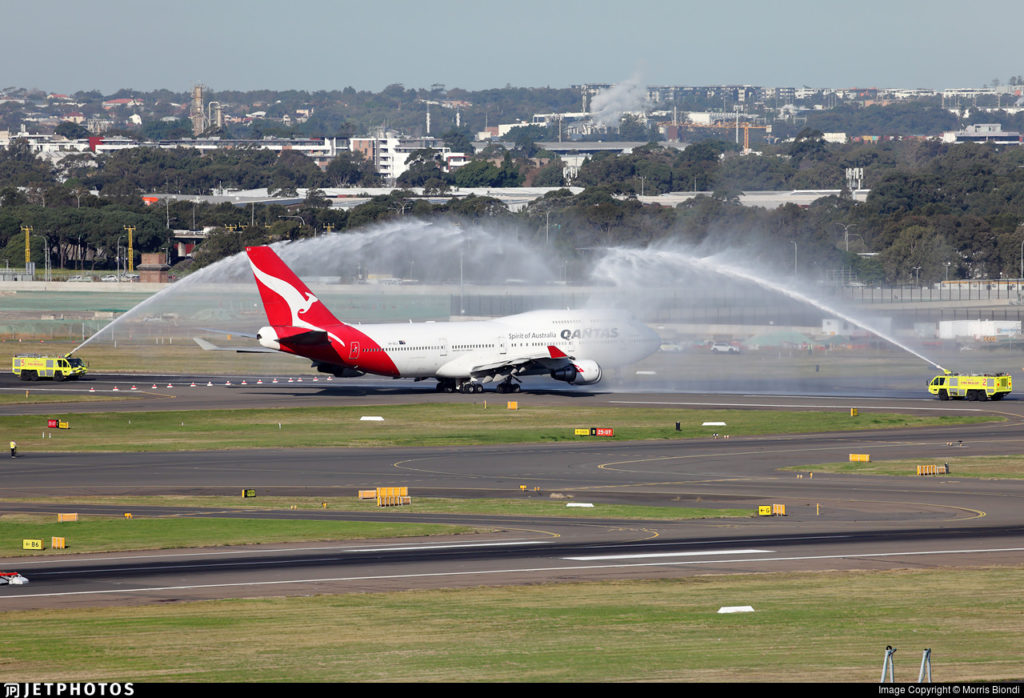
The final Qantas 747 departure from Australia left Sydney Wednesday afternoon for Los Angeles. Before heading across the Pacific, VH-OEJ took to the sky over Sydney to leave a special message. Today’s departure marks the end of the Qantas 747 fleet’s 49 years of service.
Over the past week, Qantas operated three “Farewell Jumbo Joy Flights” touring Sydney, Brisbane, and Canberra with passengers on board for the final time. Today’s flight is taking the aircraft from Sydney to Los Angeles, where it will clear customs before continuing on to its final resting place in the California desert.
After making a scenic departure over Sydney and a low pass over the Historical Aircraft Restoration Society (HARS) in Wollongong, which hosts a retired Qantas 747, QF7474 turned east over the Tasman Sea to draw Qantas’ iconic kangaroo.
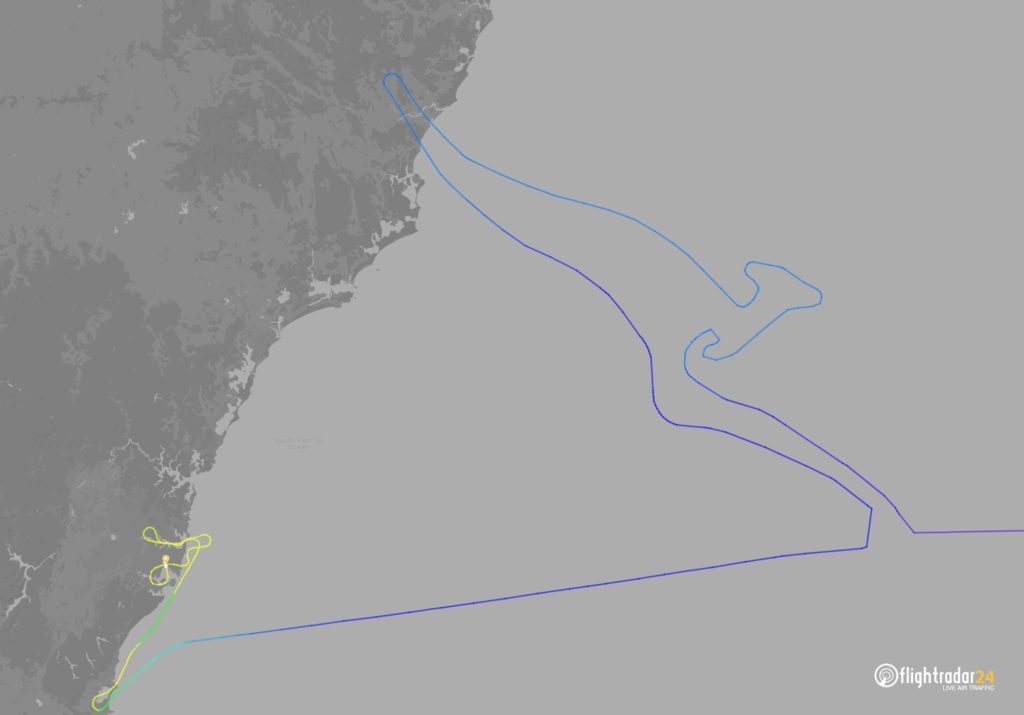
Qantas Final 747 Flight
Measuring 275 kilometers east-west and 250 km north-south, the kangaroo took slightly less than 90 minutes to complete. When finished, VH-OEJ climbed to cruising altitude for the last time and headed out over the Pacific Ocean towards Los Angeles. After resting at LAX for a day, the very last takeoff by a Qantas 747 will send VH-OEJ to Mojave where it will join its fleet mates in retirement.
Posted in News, Planes Trains and Automobiles
The Welland Canal is a ship canal in Canada that runs 42 km (27.0 miles) from Port Colborne, Ontario on Lake Erie to Port Weller, Ontario on Lake Ontario. As part of the St. Lawrence Seaway, the canal allows ships to traverse the Niagara Escarpment and avoid Niagara Falls.
Posted in Because I Can, Planes Trains and Automobiles
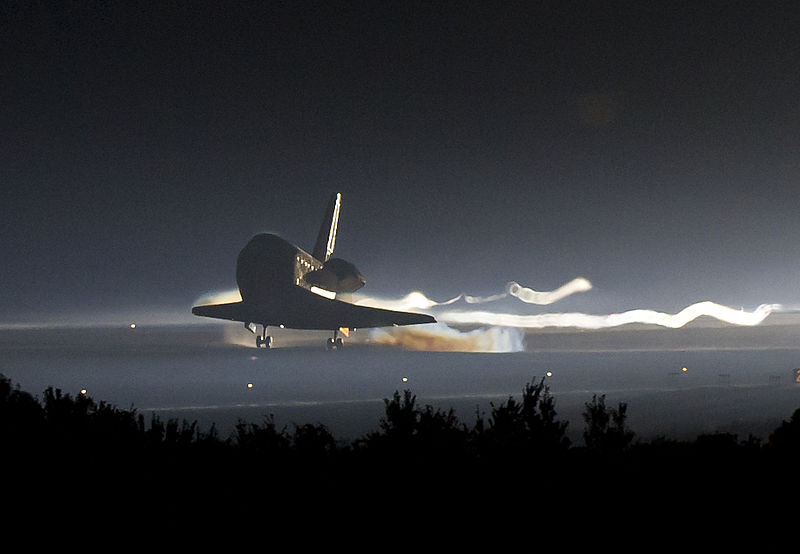
Space shuttle Atlantis lands for the STS-135 mission marking the final mission of the Space Shuttle Program at NASA’s Kennedy Space Center in Florida. Time of landing was 5:57 a.m. (EDT) on July 21, 2011.
The “just at dawn” landing was one of the most memorable landings ever, as shown in this picture:
Posted in Because I Can, Patriotic, Planes Trains and Automobiles
At 10:56 p.m. EDT July 20, 1969, American astronaut Neil Armstrong, 240,000 miles from Earth, speaks these words to more than a billion people listening at home: “That’s one small step for man, one giant leap for mankind.” Stepping off the lunar landing module Eagle, Armstrong became the first human to walk on the surface of the moon.
The American effort to send astronauts to the moon has its origins in a famous appeal President John F. Kennedy made to a special joint session of Congress on May 25, 1961: “I believe this nation should commit itself to achieving the goal, before this decade is out, of landing a man on the moon and returning him safely to Earth.” At the time, the United States was still trailing the Soviet Union in space developments, and Cold War-era America welcomed Kennedy’s bold proposal.
In 1966, after five years of work by an international team of scientists and engineers, the National Aeronautics and Space Administration (NASA) conducted the first unmanned Apollo mission, testing the structural integrity of the proposed launch vehicle and spacecraft combination. Then, on January 27, 1967, tragedy struck at Kennedy Space Center in Cape Canaveral, Florida, when a fire broke out during a manned launch-pad test of the Apollo spacecraft and Saturn rocket. Three astronauts were killed in the fire.
Despite the setback, NASA and its thousands of employees forged ahead, and in October 1968, Apollo 7, the first manned Apollo mission, orbited Earth and successfully tested many of the sophisticated systems needed to conduct a moon journey and landing. In December of the same year, Apollo 8 took three astronauts to the dark side of the moon and back, and in March 1969 Apollo 9 tested the lunar module for the first time while in Earth orbit. Then in May, the three astronauts of Apollo 10 took the first complete Apollo spacecraft around the moon in a dry run for the scheduled July landing mission.
At 9:32 a.m. on July 16, with the world watching, Apollo 11 took off from Kennedy Space Center with astronauts Neil Armstrong, Edwin Aldrin Jr., and Michael Collins aboard. Armstrong, a 38-year-old civilian research pilot, was the commander of the mission. After traveling 240,000 miles in 76 hours, Apollo 11 entered into a lunar orbit on July 19. The next day, at 1:46 p.m., the lunar module Eagle, manned by Armstrong and Aldrin, separated from the command module, where Collins remained. Two hours later, the Eagle began its descent to the lunar surface, and at 4:18 p.m. the craft touched down on the southwestern edge of the Sea of Tranquility. Armstrong immediately radioed to Mission Control in Houston, Texas, a famous message: “The Eagle has landed.”
At 10:39 p.m., five hours ahead of the original schedule, Armstrong opened the hatch of the lunar module. As he made his way down the lunar module’s ladder, a television camera attached to the craft recorded his progress and beamed the signal back to Earth, where hundreds of millions watched in great anticipation. At 10:56 p.m., Armstrong spoke his famous quote, which he later contended was slightly garbled by his microphone and meant to be “that’s one small step for a man, one giant leap for mankind.” He then planted his left foot on the gray, powdery surface, took a cautious step forward, and humanity had walked on the moon.
“Buzz” Aldrin joined him on the moon’s surface at 11:11 p.m., and together they took photographs of the terrain, planted a U.S. flag, ran a few simple scientific tests, and spoke with President Richard M. Nixon via Houston. By 1:11 a.m. on July 21, both astronauts were back in the lunar module and the hatch was closed. The two men slept that night on the surface of the moon, and at 1:54 p.m. the Eagle began its ascent back to the command module. Among the items left on the surface of the moon was a plaque that read: “Here men from the planet Earth first set foot on the moon–July 1969 A.D–We came in peace for all mankind.”
At 5:35 p.m., Armstrong and Aldrin successfully docked and rejoined Collins, and at 12:56 a.m. on July 22 Apollo 11 began its journey home, safely splashing down in the Pacific Ocean at 12:51 p.m. on July 24.
There would be five more successful lunar landing missions, and one unplanned lunar swing-by, Apollo 13. The last men to walk on the moon, astronauts Eugene Cernan and Harrison Schmitt of the Apollo 17 mission, left the lunar surface on December 14, 1972. The Apollo program was a costly and labor intensive endeavor, involving an estimated 400,000 engineers, technicians, and scientists, and costing $24 billion (close to $100 billion in today’s dollars). The expense was justified by Kennedy’s 1961 mandate to beat the Soviets to the moon, and after the feat was accomplished ongoing missions lost their viability.
Posted in Patriotic
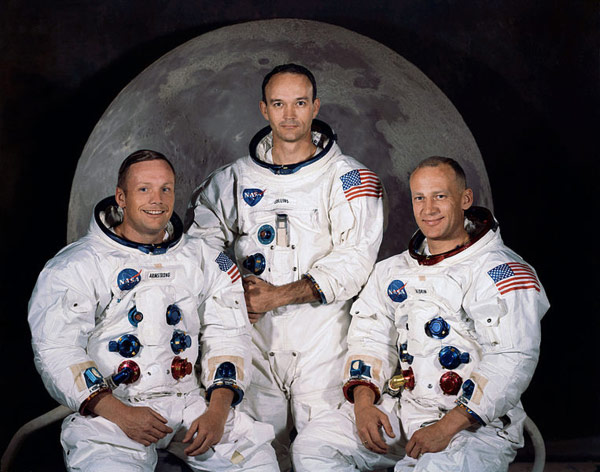
Left to right: Neil Armstrong, Michael Collins, and Buzz Aldrin, the crew of Apollo 11. Photo: NASA.
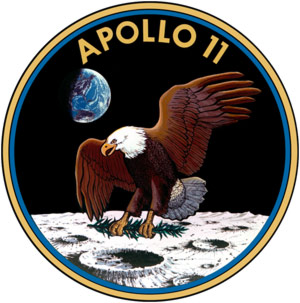
On this day in 1969, humans walked on the moon for the first time. The Apollo 11 spaceflight brought Americans Neil Armstrong and Buzz Aldrin to the lunar surface on July 20, 1969, at 20:18 UTC.
Michael Collins, the mission’s third member, remained in lunar orbit. All three men returned safely to Earth after an 8-day mission that began with a Saturn V rocket launch from Kennedy Space Center in Merritt Island, Florida on July 16.
This was the fifth manned mission of NASA’s Apollo program, which ran from 1963 to 1972 and included 6 missions that landed on the moon. These were the first and last times human beings set foot on another world.
NASA has a collection of restored HD videos well worth watching on this historic day.
Posted in On This Day, Patriotic
On this day in 1799, during Napoleon Bonaparte’s Egyptian campaign, a French soldier discovers a black basalt slab inscribed with ancient writing near the town of Rosetta, about 35 miles north of Alexandria. The irregularly shaped stone contained fragments of passages written in three different scripts: Greek, Egyptian hieroglyphics and Egyptian demotic. The ancient Greek on the Rosetta Stone told archaeologists that it was inscribed by priests honoring the king of Egypt, Ptolemy V, in the second century B.C. More startlingly, the Greek passage announced that the three scripts were all of identical meaning. The artifact thus held the key to solving the riddle of hieroglyphics, a written language that had been “dead” for nearly 2,000 years.
When Napoleon, an emperor known for his enlightened view of education, art and culture, invaded Egypt in 1798, he took along a group of scholars and told them to seize all important cultural artifacts for France. Pierre Bouchard, one of Napoleon’s soldiers, was aware of this order when he found the basalt stone, which was almost four feet long and two-and-a-half feet wide, at a fort near Rosetta. When the British defeated Napoleon in 1801, they took possession of the Rosetta Stone.
Several scholars, including Englishman Thomas Young made progress with the initial hieroglyphics analysis of the Rosetta Stone. French Egyptologist Jean-Francois Champollion (1790-1832), who had taught himself ancient languages, ultimately cracked the code and deciphered the hieroglyphics using his knowledge of Greek as a guide. Hieroglyphics used pictures to represent objects, sounds and groups of sounds. Once the Rosetta Stone inscriptions were translated, the language and culture of ancient Egypt was suddenly open to scientists as never before.
The Rosetta Stone has been housed at the British Museum in London since 1802, except for a brief period during World War I. At that time, museum officials moved it to a separate underground location, along with other irreplaceable items from the museum’s collection, to protect it from the threat of bombs.
Posted in On This Day
Solo! Hay lapa no ya, Solo!
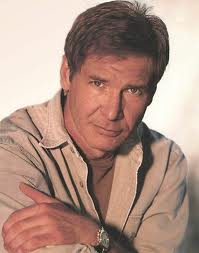
Harrison Ford (July 13, 1942 – )
Harrison Ford (born July 13, 1942) is an American film actor and producer. He is famous for his performances as Han Solo in the original Star Wars trilogy and as the title character of the Indiana Jones film series. Ford is also known for his roles as Rick Deckard in Blade Runner, John Book in Witness and Jack Ryan in Patriot Games and Clear and Present Danger. His career has spanned six decades and includes roles in several Hollywood blockbusters, including Presumed Innocent, The Fugitive, Air Force One, and What Lies Beneath. At one point, four of the top six box-office hits of all time included one of his roles. Five of his films have been inducted into the National Film Registry.
In 1997, Ford was ranked No. 1 in Empire‘s “The Top 100 Movie Stars of All Time” list. As of July 2008, the United States domestic box office grosses of Ford’s films total over US$3.5 billion, with worldwide grosses surpassing $6 billion, making Ford the third highest grossing U.S. domestic box-office star. Ford is the husband of actress Calista Flockhart.
Posted in The Big Screen
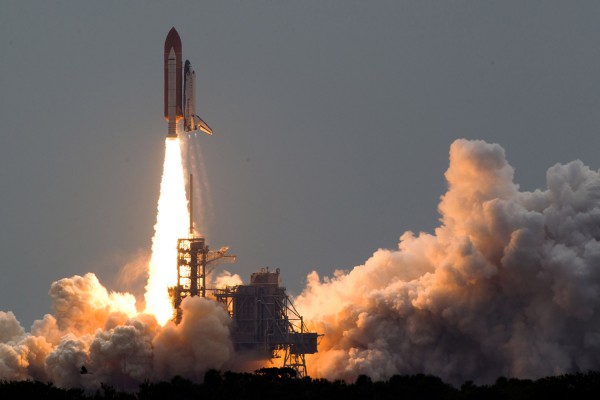
Space shuttle Atlantis launches for the STS-135 mission to the International Space Station in the final mission of the Space Shuttle Program at NASA’s Kennedy Space Center in Florida. Liftoff was at 11:29 a.m. (EDT) on July 8, 2011. Astronauts Chris Ferguson, STS-135 commander; Doug Hurley, pilot; Sandy Magnus and Rex Walheim, both mission specialists, were on board.
Posted in Because I Can, Patriotic, Planes Trains and Automobiles
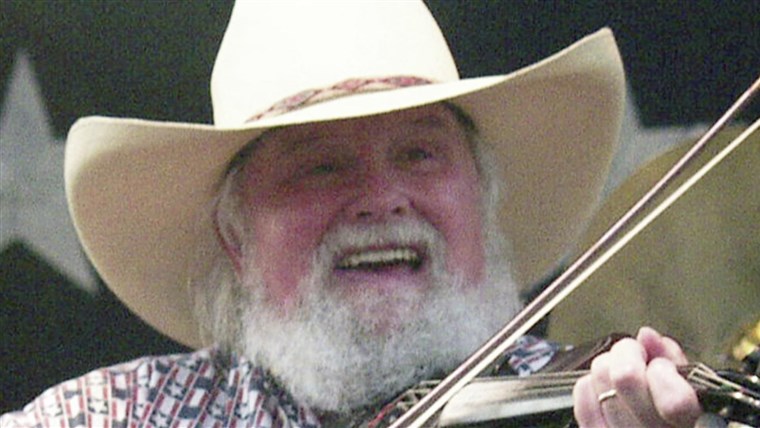
Charles Edward Daniels was an American singer, songwriter and multi-instrumentalist known for his contributions to Southern rock, country, and bluegrass music. He was best known for his number-one country hit “The Devil Went Down to Georgia“. Daniels was active as a singer and musician since the 1950s. He was inducted into the Cheyenne Frontier Days Hall of Fame in 2002, the Grand Ole Opry in 2008, the Musicians Hall of Fame and Museum in 2009, and the Country Music Hall of Fame in 2016.
Daniels died on July 6, 2020, of a hemorrhagic stroke at the age of 83.
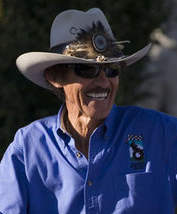
Richard Lee Petty (born July 2, 1937) is a former NASCAR driver who raced in the Strictly Stock/Grand National Era and the NASCAR Winston Cup Series. “The King”, as he is nicknamed, is most well-known for winning the NASCAR Championship seven times, winning a record 200 races during his career, winning the Daytona 500 a record seven times, and winning a record 27 races (ten of them consecutively) in the 1967 season alone. (A 1972 rule change eliminated races under 250 miles (400 km) in length, reducing the schedule to 30 (now 36) races.) Petty is widely considered one of the greatest NASCAR drivers of all time. He also collected a record number of poles (127) and over 700 top-ten finishes in his 1,185 starts, including 513 consecutive starts from 1971–1989.
Posted in Planes Trains and Automobiles