On April 4th, 1985, Max was born on British television:
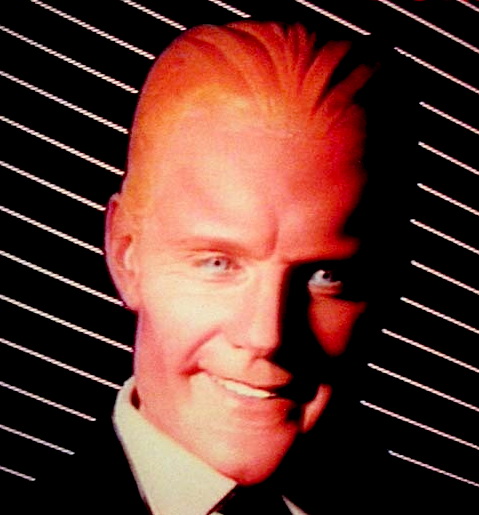
The rest is history…
To “celebrate” the 30th Anniversary of Max Headroom’s 1st TV appearance, Bryan Bishop at the Verge has an awesome article about the show:
On April 4th, 1985, Max was born on British television:
The rest is history…
To “celebrate” the 30th Anniversary of Max Headroom’s 1st TV appearance, Bryan Bishop at the Verge has an awesome article about the show:
Posted in Because I Can, The Little Screen (Television)
Just after 6 p.m. on April 4, 1968, Martin Luther King Jr. is fatally shot while standing on the balcony outside his second-story room at the Motel Lorraine in Memphis, Tennessee. The civil rights leader was in Memphis to support a sanitation workers’ strike and was on his way to dinner when a bullet struck him in the jaw and severed his spinal cord. King was pronounced dead after his arrival at a Memphis hospital. He was 39 years old.
In the months before his assassination, Martin Luther King became increasingly concerned with the problem of economic inequality in America. He planned an interracial “Poor People’s March” on Washington and in March 1968 had traveled to Memphis in support of poorly treated African-American sanitation workers. On March 28, a workers’ protest march led by King ended in violence and the death of an African-American teenager. King left the city but vowed to return in early April to lead another demonstration.
On April 3, back in Memphis, King gave his last sermon, saying, “We’ve got some difficult days ahead, but it really doesn’t matter with me now. Because I’ve been to the mountaintop. And I don’t mind. Like anybody, I would like to live a long life; longevity has its place. But I’m not concerned about that now. I just want to do God’s will. And he’s allowed me to go up to the mountain, and I’ve looked over, and I’ve seen the promised land. I may not get there with you, but I want you to know tonight that we as a people will get to the promised land.”
One day after speaking those words, Dr. King was shot and killed by a sniper. As word of the assassination spread, riots broke out in cities all across the United States and National Guard troops were deployed in Memphis and Washington, D.C. On April 9, King was laid to rest in his hometown of Atlanta, Georgia. Tens of thousands of people lined the streets to pay tribute to King’s casket as it passed by in a wooden farm cart drawn by a single mule.
The evening of King’s murder, a Remington .30-06 hunting rifle was found on the sidewalk beside a rooming house one block from the Lorraine Motel. During the next several weeks, the rifle, eyewitness reports, and fingerprints on the weapon all implicated a single suspect: escaped convict James Earl Ray. A two-bit criminal, Ray escaped a Missouri prison in April 1967 while serving a sentence for a holdup. In May 1968, a massive manhunt for Ray began. The FBI eventually determined that he had obtained a Canadian passport under a false identity, which at the time was relatively easy.
On June 8, Scotland Yard investigators arrested Ray at a London airport. He was trying to fly to Belgium, with the eventual goal, he later admitted, of reaching Rhodesia. Rhodesia, now called Zimbabwe, was at the time ruled by an oppressive and internationally condemned white minority government. Extradited to the United States, Ray stood before a Memphis judge in March 1969 and pleaded guilty to King’s murder in order to avoid the electric chair. He was sentenced to 99 years in prison.
Three days later, he attempted to withdraw his guilty plea, claiming he was innocent of King’s assassination and had been set up as a patsy in a larger conspiracy. He claimed that in 1967, a mysterious man named “Raoul” had approached him and recruited him into a gunrunning enterprise. On April 4, 1968, he said, he realized that he was to be the fall guy for the King assassination and fled to Canada. Ray’s motion was denied, as were his dozens of other requests for a trial during the next 29 years.
During the 1990s, the widow and children of Martin Luther King Jr. spoke publicly in support of Ray and his claims, calling him innocent and speculating about an assassination conspiracy involving the U.S. government and military. U.S. authorities were, in conspiracists’ minds, implicated circumstantially. FBI Director J. Edgar Hoover obsessed over King, who he thought was under communist influence. For the last six years of his life, King underwent constant wiretapping and harassment by the FBI. Before his death, Dr. King was also monitored by U.S. military intelligence, which may have been asked to watch King after he publicly denounced the Vietnam War in 1967. Furthermore, by calling for radical economic reforms in 1968, including guaranteed annual incomes for all, King was making few new friends in the Cold War-era U.S. government.
Over the years, the assassination has been reexamined by the House Select Committee on Assassinations, the Shelby County, Tennessee, district attorney’s office, and three times by the U.S. Justice Department. The investigations all ended with the same conclusion: James Earl Ray killed Martin Luther King. The House committee acknowledged that a low-level conspiracy might have existed, involving one or more accomplices to Ray, but uncovered no evidence to definitively prove this theory. In addition to the mountain of evidence against him–such as his fingerprints on the murder weapon and his admitted presence at the rooming house on April 4–Ray had a definite motive in assassinating King: hatred. According to his family and friends, he was an outspoken racist who informed them of his intent to kill Dr. Martin Luther King, Jr. He died in 1998.
Posted in Events
Ignore the girls (if you want) – but check out these cars!!! (Oh, and the music!)
https://youtu.be/T95NMc9qHto
Posted in Music, Planes Trains and Automobiles
The Lockheed F-104 Starfighter, also known as the “Missile With A Man In It,” is known for many things. It was the first operational mach two capable fighter, it was designed by the legendary Kelly Johnson and served with 15 nations for almost 50 years. One thing it is not known for is its slow-speed handling.

Posted in Planes Trains and Automobiles
On this day in 1860, the first Pony Express mail, traveling by horse and rider relay teams, simultaneously leaves St. Joseph, Missouri, and Sacramento, California. Ten days later, on April 13, the westbound rider and mail packet completed the approximately 1,800-mile journey and arrived in Sacramento, beating the eastbound packet’s arrival in St. Joseph by two days and setting a new standard for speedy mail delivery. Although ultimately short-lived and unprofitable, the Pony Express captivated America’s imagination and helped win federal aid for a more economical overland postal system. It also contributed to the economy of the towns on its route and served the mail-service needs of the American West in the days before the telegraph or an efficient transcontinental railroad.
The Pony Express debuted at a time before radios and telephones, when California, which achieved statehood in 1850, was still largely cut off from the eastern part of the country. Letters sent from New York to the West Coast traveled by ship, which typically took at least a month, or by stagecoach on the recently established Butterfield Express overland route, which could take from three weeks to many months to arrive. Compared to the snail’s pace of the existing delivery methods, the Pony Express’ average delivery time of 10 days seemed like lightning speed.
The Pony Express Company, the brainchild of William H. Russell, William Bradford Waddell and Alexander Majors, owners of a freight business, was set up over 150 relay stations along a pioneer trail across the present-day states of Missouri, Kansas, Nebraska, Wyoming, Colorado, Utah, Nevada and California. Riders, who were paid approximately per week and carried loads estimated at up to 20 pounds of mail, were changed every 75 to 100 miles, with horses switched out every 10 to 15 miles. Among the riders was the legendary frontiersman and showman William “Buffalo Bill” Cody (1846-1917), who reportedly signed on with the Pony Express at age 14. The company’s riders set their fastest time with Lincoln’s inaugural address, which was delivered in just less than eight days.
The initial cost of Pony Express delivery was for every half-ounce of mail. The company began as a private enterprise and its owners hoped to gain a profitable delivery contract from the U.S. government, but that never happened. With the advent of the first transcontinental telegraph line in October 1861, the Pony Express ceased operations. However, the legend of the lone Pony Express rider galloping across the Old West frontier to deliver the mail lives on today
Posted in Critters

The Feadship Fanclub Facebook community posted a photo of the giant Project 808 Symphony yacht by Feadship Yachts traveling through the Gouwe Aquaduct in Gouda, The Netherlands as it passes over the A12 motorway.
Posted in Planes Trains and Automobiles

It’s called The Beer Engine. The Hogs Back Brewery in Tongham, Surrey, UK commissioned this custom motorcycle. As you can see, the sidecar is a beer keg, spigot and all. The gear shift lever is a beer engine pull. The owners use the motorcycle to draw the attention of crowds at festivals and other public events.
Posted in Planes Trains and Automobiles
In autumn 2014, photographer Fox Grom captured gorgeously ethereal images of his two beautiful huskies named Alaska and Blizzard as they wandered across a frozen lake in Northern Russia minutes after a rain shower. The effect of the rainfall on the ice made it appear as if the majestic canines were walking on water that reflected their images perfectly. Grom told the Daily Mail that he always takes pictures of his dogs when they go walking.
I always take pictures of my dogs whilst walking them but on this occasion there was an extraordinary phenomenon. The ice was already very thick when it rained heavily making for a spectacular scene.


Posted in Critters
2015 Mid-America Trucking Show | March 26 – 28, 2015 | Louisville, KY at the Kentucky Exposition Center
Posted in Because I Can, Planes Trains and Automobiles

Click for larger image
The arctic blast that’s kept much of the northeastern United States buried under snow and ice this winter has caused its share of troubles, but it’s also prompted some incredible natural scenery, such as this view of Niagara Falls partially frozen.
It’s not unusual for portions of Niagara’s American Falls to freeze during the cold winters here at the border between New York and Ontario. In 1909, 1936, 1939, and 1949, the American Falls froze over almost completely, with the running water reduced to a trickle. But it was the March 29, 1848 ice jam on Lake Erie that brought all three of Niagara’s falls (American Falls, Horseshoe Falls, and Bridal Veil Falls) to a strange, silent stop.
Niagara’s winter conditions became more newsworthy this year when two ice climbers used the opportunity to set world records: On January 27, Will Gadd and Sarah Hueniken became the first man and woman to climb the frozen falls. They scaled a wall of ice on the left side of Horseshoe Falls, the largest of Niagara’s three falls.
Posted in Because I Can