
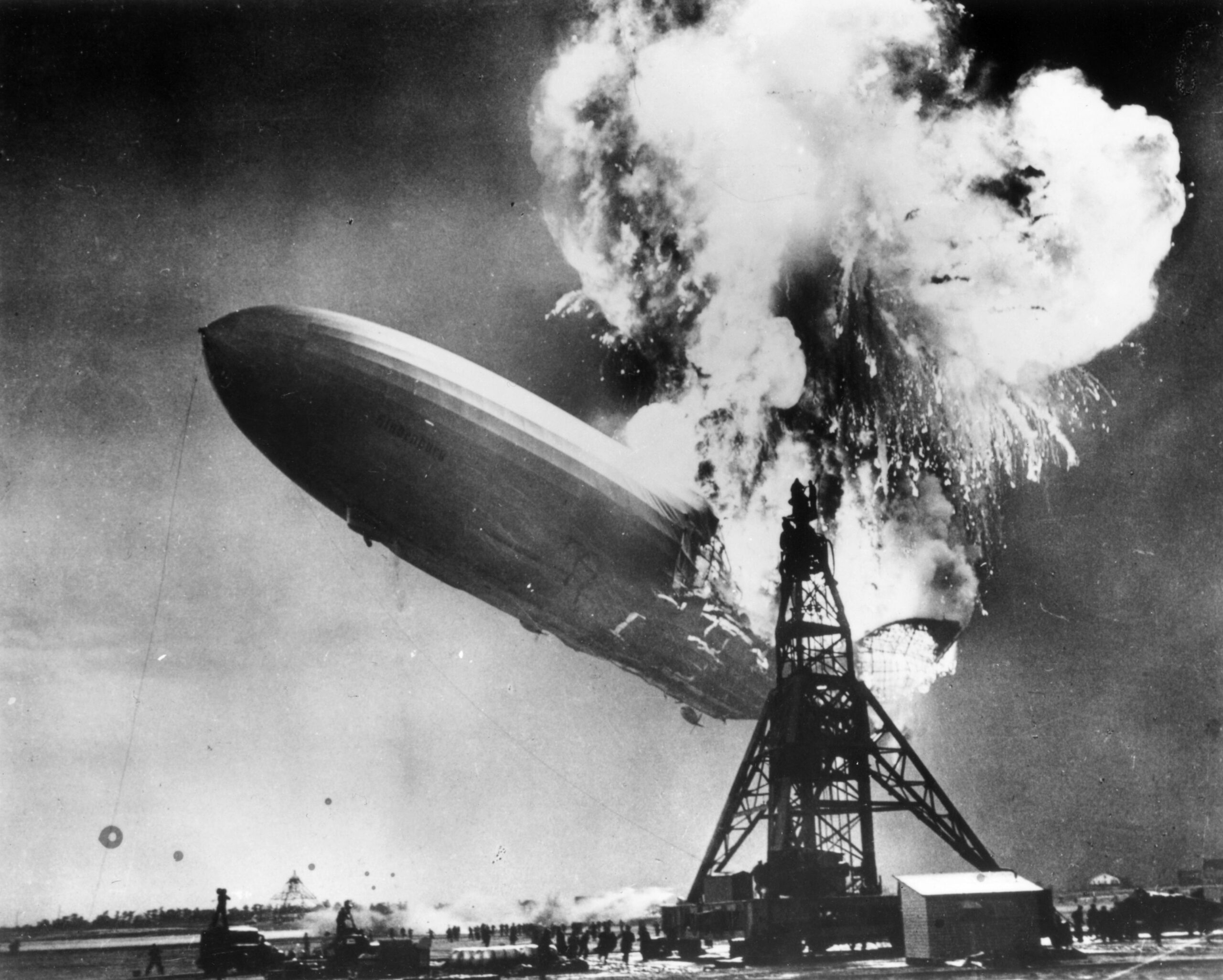
On May 6,1937, the airship Hindenburg, the largest dirigible ever built and the pride of Nazi Germany, bursts into flames upon touching its mooring mast in Lakehurst, New Jersey, killing 36 passengers and crewmembers.
Posted in On This Day, Planes Trains and Automobiles
From Cape Canaveral, Florida, Navy Commander Alan Bartlett Shepard Jr. is launched into space aboard the Freedom 7 space capsule, becoming the first American astronaut to travel into space. The suborbital flight, which lasted 15 minutes and reached a height of 116 miles into the atmosphere, was a major triumph for the National Aeronautics and Space Administration (NASA).
Posted in Because I Can, Patriotic
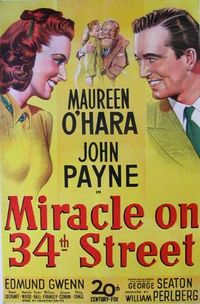
Miracle on 34th Street (also titled The Big Heart in the UK) is a 1947 film which tells the story of a gentle old man, working as a Santa Claus at Macy’s department store in New York City, who contends that he is the real deal.
Posted in Because I Can, On This Day, The Big Screen
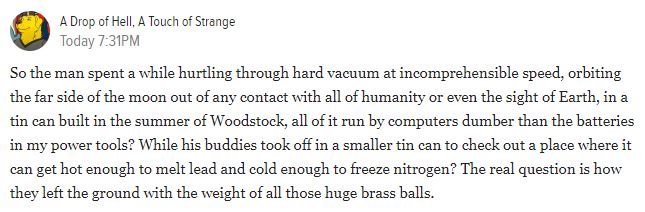
Read this over on Jalopnik’s piece on Michael Collins. First commenter nailed it:
Posted in Because I Can
On July 16, 1969 three men, Buzz Aldrin, Neil Armstrong, and Michael Collins launched into the sky aboard Saturn V AS-506 to start the Apollo 11 mission.
Four days later, on July 20, 1969, Buzz and Neil entered the Eagle to begin preparations for lunar landing. Later, Eagle separated from Columbia to begin descent to the lunar surface.
Armstrong stepped off Eagle’s footpad and declared: “That’s one small step for [a] man, one giant leap for mankind.” The first human had stepped foot on the Moon.
Buzz joined Armstrong a few minutes later with the simple phrase: “Magnificent desolation.”
But, during the entire process, Michael Collins orbited the Moon. Alone. Forty eight minutes of each orbit he was out of radio contact with the Earth as Columbia passed the far side of the Moon. “Not since Adam has any human known such solitude as Mike Collins,” the mission log said.
Michael Collins passed away today at age 90.
And then there was one…
Posted in Because I Can, News, Patriotic
On April 26, 1986, the world’s worst nuclear power plant accident occurs at the Chernobyl nuclear power station in the Soviet Union. Thirty-two people died and dozens more suffered radiation burns in the opening days of the crisis, but only after Swedish authorities reported the fallout did Soviet authorities reluctantly admit that an accident had occurred.
The Chernobyl station was situated at the settlement of Pripyat, about 65 miles north of Kiev in the Ukraine. Built in the late 1970s on the banks of the Pripyat River, Chernobyl had four reactors, each capable of producing 1,000 megawatts of electric power. On the evening of April 25, 1986, a group of engineers began an electrical-engineering experiment on the Number 4 reactor. The engineers, who had little knowledge of reactor physics, wanted to see if the reactor’s turbine could run emergency water pumps on inertial power.
As part of their poorly designed experiment, the engineers disconnected the reactor’s emergency safety systems and its power-regulating system. Next, they compounded this recklessness with a series of mistakes: They ran the reactor at a power level so low that the reaction became unstable, and then removed too many of the reactor’s control rods in an attempt to power it up again. The reactor’s output rose to more than 200 megawatts but was proving increasingly difficult to control. Nevertheless, at 1:23 a.m. on April 26, the engineers continued with their experiment and shut down the turbine engine to see if its inertial spinning would power the reactor’s water pumps. In fact, it did not adequately power the water pumps, and without cooling water the power level in the reactor surged.
To prevent meltdown, the operators reinserted all the 200-some control rods into the reactor at once. The control rods were meant to reduce the reaction but had a design flaw: graphite tips. So, before the control rod’s five meters of absorbent material could penetrate the core, 200 graphite tips simultaneously entered, thus facilitating the reaction and causing an explosion that blew off the heavy steel and concrete lid of the reactor. It was not a nuclear explosion, as nuclear power plants are incapable of producing such a reaction, but was chemical, driven by the ignition of gases and steam that were generated by the runaway reaction. In the explosion and ensuing fire, more than 50 tons of radioactive material were released into the atmosphere, where it was carried by air currents.
On April 27, Soviet authorities began an evacuation of the 30,000 inhabitants of Pripyat. A cover-up was attempted, but on April 28 Swedish radiation monitoring stations, more than 800 miles to the northwest of Chernobyl, reported radiation levels 40 percent higher than normal. Later that day, the Soviet news agency acknowledged that a major nuclear accident had occurred at Chernobyl.
In the opening days of the crisis, 32 people died at Chernobyl and dozens more suffered radiation burns. The radiation that escaped into the atmosphere, which was several times that produced by the atomic bombs dropped on Hiroshima and Nagasaki, was spread by the wind over Northern and Eastern Europe, contaminating millions of acres of forest and farmland. An estimated 5,000 Soviet citizens eventually died from cancer and other radiation-induced illnesses caused by their exposure to the Chernobyl radiation, and millions more had their health adversely affected. In 2000, the last working reactors at Chernobyl were shut down and the plant was officially closed.
Posted in Because I Can, On This Day