Author Archives: James

Dammit, Jim!

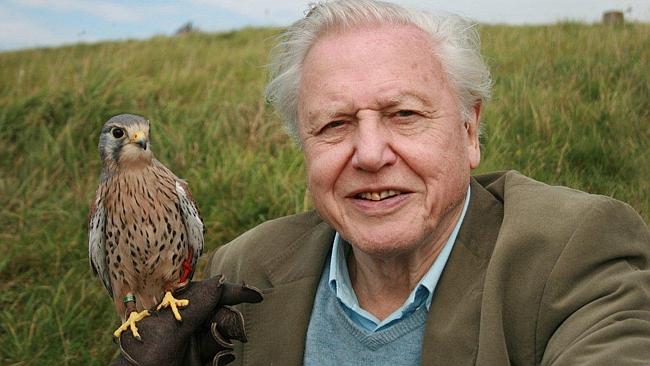
Happy Birthday, Sir David Attenborough

Sir David Attenborough (May 8th 1926 - )

Sir David Attenborough (May 8th 1926 – )

Wikipedia Article

Sir David Frederick Attenborough is an English broadcaster and naturalist.

He is best known for writing and presenting the nine Life series, in conjunction with the BBC Natural History Unit, which collectively form a comprehensive survey of animal and plant life on the planet. He is also a former senior manager at the BBC, having served as controller of BBC Two and director of programming for BBC Television in the 1960s and 1970s. He is the only person to have won BAFTAs for programs in each of black and white, colour, HD, and 3D.

Attenborough is widely considered a national treasure in Britain, although he himself does not like the term. In 2002 he was named among the 100 Greatest Britons following a UK-wide vote. He is the younger brother of director, producer and actor Richard Attenborough.

Lusitania sinks

Lusitania sinks

On the afternoon of May 7, 1915, the British ocean liner Lusitania is torpedoed without warning by a German submarine off the south coast of Ireland. Within 20 minutes, the vessel sank into the Celtic Sea. Of 1,959 passengers and crew, 1,198 people were drowned, including 128 Americans. The attack aroused considerable indignation in the United States, but Germany defended the action, noting that it had issued warnings of its intent to attack all ships, neutral or otherwise, that entered the war zone around Britain.

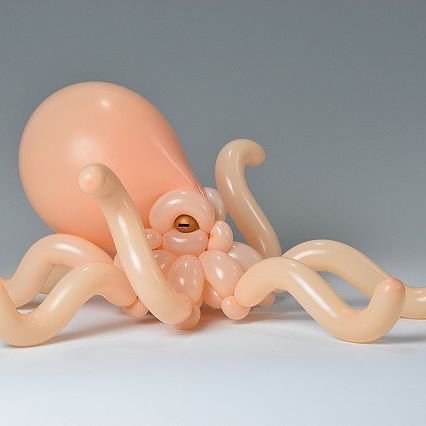
Isopresso Balloon

See the entire collection here.


The Hindenburg Disaster

The Hindenburg Disaster

On May 6,1937, the airship Hindenburg, the largest dirigible ever built and the pride of Nazi Germany, bursts into flames upon touching its mooring mast in Lakehurst, New Jersey, killing 36 passengers and crewmembers.

1961 : The first American in space

From Cape Canaveral, Florida, Navy Commander Alan Bartlett Shepard Jr. is launched into space aboard the Freedom 7 space capsule, becoming the first American astronaut to travel into space. The suborbital flight, which lasted 15 minutes and reached a height of 116 miles into the atmosphere, was a major triumph for the National Aeronautics and Space Administration (NASA).

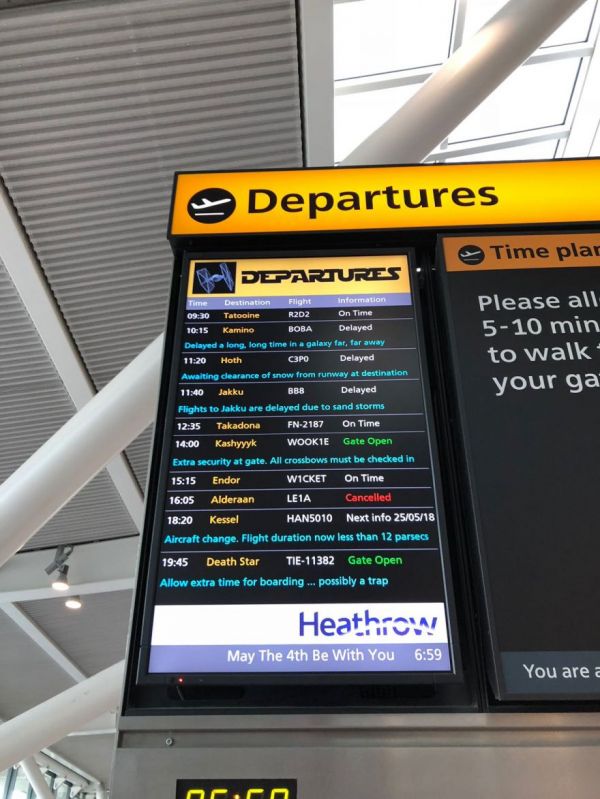
Departures on May the 4th

The departure screen at Heathrow Airport in London was a little different as May 4th dawned. You can enlarge the picture here. The flight to Hoth has been delayed because of snow on the destination runway. The flight going to Kashyyyk is numbered WOOK1E. And sadly, Flight LE1A to Alderaan has been cancelled. 

May the 4th Be With You

May the 4th

Somewhere Expensive

Two Hours Trapped On A Hanging Roller Coaster

The only thing more terrifying than being stuck on a roller coaster, is being stuck at the highest part of the ride. And the only thing more terrifying than that is if it happens to be one of those coasters where you’re hanging down from a harness, leaving nothing but 98-feet of free-fall space between you and the ground.

Read the rest here.

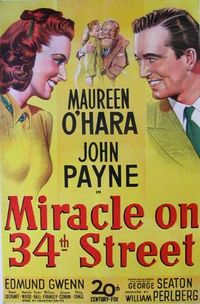
Anniversary of Miracle on 34th Street

Miracle on 34th Street (also titled The Big Heart in the UK) is a 1947 film which tells the story of a gentle old man, working as a Santa Claus at Macy’s department store in New York City, who contends that he is the real deal.

Miracle on 34th Street

Wikipedia Link

The film was released in theaters May 2, 1947.


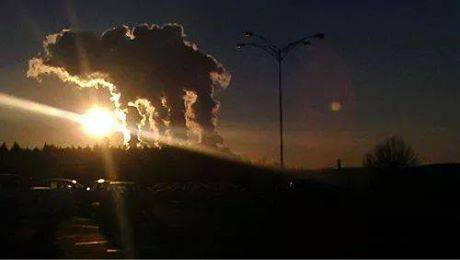
Cloud AT-AT

Fanny Floss

Trapped

So a cat walks into a deli

In a truly heartwarming display of affection, a smiling deli clerk was amused by a stray cat who wandered into his store, stood up on hind legs (while leaning against the glass of the counter) and meowed for a bit of attention. The clerk quite humorously presented different cuts of meat for the feline’s approval. After pointing out which cut was the best, the cat was rewarded with a healthy piece of meat.

This cat walked into a deli and made their way over to the counter. After standing up on their hind legs, they watched as an employee showed them various cuts of meat before they were fed a small piece.

Water for your Dog

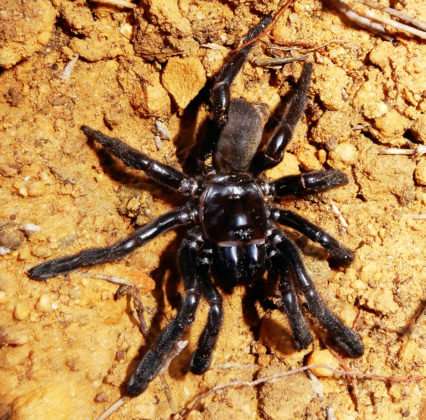
RIP Number 16 – Dead at age 43

This female trapdoor spider, named Number 16, was the world’s oldest known spider. A lifelong resident of the Australian outback, she has just died at age 43.

From Curtin University:

The research, published in the Pacific Conservation Biology Journal, suggests the 43-year-old Giaus Villosus trapdoor matriarch, who recently died during a long-term population study, had outlived the previous world record holder, a 28-year old tarantula found in Mexico.

Lead author PhD student Leanda Mason from the School of Molecular and Life Sciences at Curtin University said the ongoing research has led to new discoveries about the longevity of the trapdoor spider.

“To our knowledge this is the oldest spider ever recorded, and her significant life has allowed us to further investigate the trapdoor spider’s behaviour and population dynamics,” Ms Mason said.

“The research project was first initiated by Barbara York Main in 1974, who monitored the long-term spider population for over 42 years in the Central Wheatbelt region of Western Australia.

“Through Barbara’s detailed research, we were able to determine that the extensive life span of the trapdoor spider is due to their life-history traits, including how they live in uncleared, native bushland, their sedentary nature and low metabolisms.”

1972 McDonald’s Menu

Bob Dorough – Ready or not, Here I Come!

For those of you who learned math, grammar, history and civic on the ABC Saturday morning program “Schoolhouse Rock!”, you can thank Bob Dorough.  Bob passed away April 23, 2018 at the age of 94.  I guess he was ready.

My personal favorite:

https://youtu.be/n3pb73onvK8

Thanks, Bob!

In Remembrance – Nuclear Disaster at Chernobyl

NUCLEAR DISASTER AT CHERNOBYL:

On April 26, 1986, the world’s worst nuclear power plant accident occurs at the Chernobyl nuclear power station in the Soviet Union. Thirty-two people died and dozens more suffered radiation burns in the opening days of the crisis, but only after Swedish authorities reported the fallout did Soviet authorities reluctantly admit that an accident had occurred.

The Chernobyl station was situated at the settlement of Pripyat, about 65 miles north of Kiev in the Ukraine. Built in the late 1970s on the banks of the Pripyat River, Chernobyl had four reactors, each capable of producing 1,000 megawatts of electric power. On the evening of April 25, 1986, a group of engineers began an electrical-engineering experiment on the Number 4 reactor. The engineers, who had little knowledge of reactor physics, wanted to see if the reactor’s turbine could run emergency water pumps on inertial power.

As part of their poorly designed experiment, the engineers disconnected the reactor’s emergency safety systems and its power-regulating system. Next, they compounded this recklessness with a series of mistakes: They ran the reactor at a power level so low that the reaction became unstable, and then removed too many of the reactor’s control rods in an attempt to power it up again. The reactor’s output rose to more than 200 megawatts but was proving increasingly difficult to control. Nevertheless, at 1:23 a.m. on April 26, the engineers continued with their experiment and shut down the turbine engine to see if its inertial spinning would power the reactor’s water pumps. In fact, it did not adequately power the water pumps, and without cooling water the power level in the reactor surged.

To prevent meltdown, the operators reinserted all the 200-some control rods into the reactor at once. The control rods were meant to reduce the reaction but had a design flaw: graphite tips. So, before the control rod’s five meters of absorbent material could penetrate the core, 200 graphite tips simultaneously entered, thus facilitating the reaction and causing an explosion that blew off the heavy steel and concrete lid of the reactor. It was not a nuclear explosion, as nuclear power plants are incapable of producing such a reaction, but was chemical, driven by the ignition of gases and steam that were generated by the runaway reaction. In the explosion and ensuing fire, more than 50 tons of radioactive material were released into the atmosphere, where it was carried by air currents.

On April 27, Soviet authorities began an evacuation of the 30,000 inhabitants of Pripyat. A cover-up was attempted, but on April 28 Swedish radiation monitoring stations, more than 800 miles to the northwest of Chernobyl, reported radiation levels 40 percent higher than normal. Later that day, the Soviet news agency acknowledged that a major nuclear accident had occurred at Chernobyl.

In the opening days of the crisis, 32 people died at Chernobyl and dozens more suffered radiation burns. The radiation that escaped into the atmosphere, which was several times that produced by the atomic bombs dropped on Hiroshima and Nagasaki, was spread by the wind over Northern and Eastern Europe, contaminating millions of acres of forest and farmland. An estimated 5,000 Soviet citizens eventually died from cancer and other radiation-induced illnesses caused by their exposure to the Chernobyl radiation, and millions more had their health adversely affected. In 2000, the last working reactors at Chernobyl were shut down and the plant was officially closed.