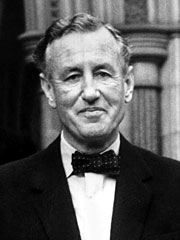
Ian Lancaster Fleming (May 28, 1908 – August 12, 1964)
Ian Lancaster Fleming was an English author and journalist, best remembered for writing the James Bond series of novels as well as the children’s story, Chitty Chitty Bang Bang.
Ian Lancaster Fleming (May 28, 1908 – August 12, 1964)
Ian Lancaster Fleming was an English author and journalist, best remembered for writing the James Bond series of novels as well as the children’s story, Chitty Chitty Bang Bang.
Posted in Because I Can, Literary, The Big Screen
On May 27, 1941, the British navy sinks the German battleship Bismarck in the North Atlantic near France. The German death toll was more than 2,000.
On February 14, 1939, the 823-foot Bismarck was launched at Hamburg. Nazi leader Adolf Hitler hoped that the state-of-the-art battleship would herald the rebirth of the German surface battle fleet. However, after the outbreak of war, Britain closely guarded ocean routes from Germany to the Atlantic Ocean, and only U-boats moved freely through the war zone.
In May 1941, the order was given for the Bismarck to break out into the Atlantic. Once in the safety of the open ocean, the battleship would be almost impossible to track down, all the while wreaking havoc on Allied convoys to Britain. Learning of its movement, Britain sent almost the entire British Home Fleet in pursuit. On May 24, the British battle cruiser Hood and battleship Prince of Wales intercepted it near Iceland. In a ferocious battle, the Hood exploded and sank, and all but three of the 1,421 crewmen were killed. The Bismarck escaped, but because it was leaking fuel it fled for occupied France. On May 26, it was sighted and crippled by British aircraft, and on May 27 three British warships descended on the Bismarck and finished it off.
Posted in On This Day
Hank Williams, Jr. is an American country and southern rock artist, son of country music pioneer Hank Williams and father of Hank III and Holly Williams.
Known by the nickname Bocephus (a name given to him by his father because he thought his son as a baby resembled a TV ventriloquist dummy named Bocephus), he was raised by his mother Audrey after his father’s death in 1953. He was destined for fame, being taught how to play piano by Jerry Lee Lewis and guitar by Johnny Cash. He began performing when eight years old.
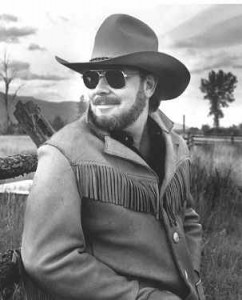
Hank Williams, Jr. (May 26, 1949 – )
Posted in Because I Can

May 25, 1977, Memorial Day weekend opens with an intergalactic bang as the first of George Lucas’ blockbuster Star Wars movies hits American theaters.
Posted in Because I Can, On This Day, The Big Screen

Today is Towel Day, a day of remembrance for Douglas Adams, author of the Hitchhikers’ Guide to the Galaxy. Observe it by carrying a towel all day.
Link
Posted in Because I Can
Ronald James Padavona (July 10, 1942 – May 16, 2010), better known as Ronnie James Dio, was an Italian-American heavy metal vocalist and songwriter. He performed with, amongst others, Elf, Rainbow, Black Sabbath, Heaven & Hell, and his own band Dio. He was widely hailed as the most powerful singer in heavy metal, renowned for his consistently powerful voice. He consistently ranks as one of the greatest rock vocalists of all time in various online polls and lists. He is credited with popularizing the “devil horns” hand gesture in metal culture. Prior to his death, he was collaborating on a project with former Black Sabbath bandmates Tony Iommi, Geezer Butler, and Vinny Appice, under the moniker Heaven & Hell, whose first studio album, The Devil You Know, was released on April 28, 2009. Dio died of stomach cancer on May 16, 2010. One of the last songs he recorded was titled “Metal Will Never Die”.

Ronald James Padavona (July 10, 1942 – May 16, 2010), better known as Ronnie James Dio.
Posted in Music
James Maury Henson (September 24, 1936 – May 16, 1990) was the most widely known American puppeteer in modern American television history.
He was the creator of The Muppets and the leading force behind their long creative run. Henson brought an engaging cast of characters, innovative ideas, and a sense of timing and humor to millions of people. He is also widely acknowledged for the ongoing vision of faith, friendship, magic, and love which was infused in nearly all of his work.

Statue of Jim Henson and Kermit the Frog, on display outside of Adele H. Stamp Student Union in College Park, Maryland.
Posted in The Big Screen, The Little Screen (Television)

Flags at half-staff today to honor fallen officers
Flags are to fly at half-staff today for Peace Officers Memorial Day. Gov. Rendell has ordered Pennsylvania flags at state facilities to be flown at half-staff, and President Obama directed the same for U.S. flags.
“On this day, we pay tribute to the local, state, and federal law enforcement officers who provide a vital public service and, too often, pay the ultimate sacrifice to safeguard the rights and freedoms of our citizens,” Rendell said in a statement. “We honor them for their character, leadership, and courage.”
In 1962, President John F. Kennedy and Congress designated May 15 as Peace Officers Memorial Day. The calendar week in which May 15 falls is National Police Week.
Posted in On This Day, Patriotic
On May 15, 1941, the jet-propelled Gloster-Whittle E 28/39 aircraft flies successfully over Cranwell, England, in the first test of an Allied aircraft using jet propulsion. The aircraft’s turbojet engine, which produced a powerful thrust of hot air, was devised by Frank Whittle, an English aviation engineer and pilot generally regarded as the father of the jet engine.
Whittle, born in Coventry in 1907, was the son of a mechanic. At the age of 16, he joined the Royal Air Force (RAF) as an aircraft apprentice at Cranwell and in 1926 passed a medical exam to become a pilot and joined the RAF College. He won a reputation as a daredevil flier and in 1928 wrote a senior thesis entitled Future Developments in Aircraft Design, which discussed the possibilities of rocket propulsion.
From the first Wright brothers flight in 1903 to the first jet flight in 1939, most airplanes were propeller driven. In 1910, the French inventor Henri Coanda built a jet-propelled bi-plane, but it crashed on its maiden flight and never flew again. Coanda’s aircraft attracted little notice, and engineers stuck with propeller technology; even though they realized early on that propellers would never overcome certain inherent limitations, especially in regard to speed.
After graduating from the RAF college, Whittle was posted to a fighter squadron, and in his spare time he worked out the essentials of the modern turbojet engine. A flying instructor, impressed with his propulsion ideas, introduced him to the Air Ministry and a private turbine engineering firm, but both ridiculed Whittle’s ideas as impractical. In 1930, he patented his jet engine concept and in 1936 formed the company Power Jets Ltd. to build and test his invention. In 1937, he tested his first jet engine on the ground. He still received only limited funding and support, and on August 27, 1939, the German Heinkel He 178, designed by Hans Joachim Pabst von Ohain, made the first jet flight in history. The German prototype jet was developed independently of Whittle’s efforts.
One week after the flight of the He 178, World War II broke out in Europe, and Whittle’s project got a further lease of life. The Air Ministry commissioned a new jet engine from Power Jets and asked the Gloster Aircraft Company to build an experimental aircraft to accommodate it, specified as E 28/39. On May 15, 1941, the jet-propelled Gloster-Whittle E 28/39 flew, beating out a jet prototype being developed by the same British turbine company that earlier balked at his ideas. In its initial tests, Whittle’s aircraft–flown by the test pilot Gerry Sayer–achieved a top speed of 370 mph at 25,000 feet, faster than the Spitfire or any other conventional propeller-driven machine.
As the Gloster Aircraft Company worked on an operational turbojet aircraft for combat, Whittle aided the Americans in their successful development of a jet prototype. With Whittle’s blessing, the British government took over Power Jets Ltd. in 1944. By this time, Britain’s Gloster Meteor jet aircraft were in service with the RAF, going up against Germany’s jet-powered Messerschmitt Me 262s in the skies over Europe.
Whittle retired from the RAF in 1948 with the rank of air commodore. That year, he was awarded 100,000 pounds by the Royal Commission on Awards to Inventors and was knighted. His book Jet: The Story of a Pioneer was published in 1953. In 1977, he became a research professor at the United States Naval Academy in Annapolis, Maryland. He died in Columbia, Maryland, in 1996.
Posted in Patriotic, Planes Trains and Automobiles