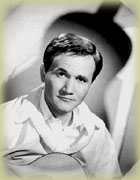
Roger Dean Miller (January 2, 1936 – October 25, 1992)
Roger Miller was an American singer, songwriter, and musician.
Wikipedia Link
Roger Dean Miller (January 2, 1936 – October 25, 1992)
Roger Miller was an American singer, songwriter, and musician.
Wikipedia Link
Posted in Because I Can, Music
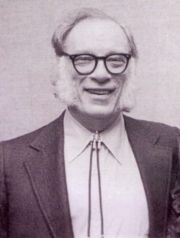
Isaac Asimov (c. January 2, 1920 – April 6, 1992)
Dr. Isaac Asimov was a Russian-born American Jewish author and biochemist, a highly successful and exceptionally prolific writer best known for his works of science fiction and for his popular science books. Asimov’s most famous work is the Foundation Series, which was part of one of his two major series, the Galactic Empire Series, later merged with his other famous story arc, the Robot series. He also wrote mysteries and fantasy, as well as a great amount of non-fiction. Asimov wrote or edited more than 500 volumes and an estimated 90,000 letters or postcards, and he has works in every major category of the Dewey Decimal System except Philosophy. Asimov was by consensus a master of the science-fiction genre and, along with Robert A. Heinlein and Arthur C. Clarke, was considered to be one of the “Big Three” science-fiction writers during his lifetime.
Most of Asimov’s popularized science books explain scientific concepts in a historical way, going back as far as possible to a time when the science in question was at its simplest stage. He often gives nationalities, birth dates and death dates for the scientists he mentions, as well as etymologies and pronunciation guides for technical terms.
The Three Laws of Robotics (often shortened to The Three Laws or Three Laws) are a set of rules devised by the science fiction author Isaac Asimov and later added to. The rules were introduced in his 1942 short story “Runaround”, although they were foreshadowed in a few earlier stories. The Three Laws are:
Posted in Because I Can, Literary
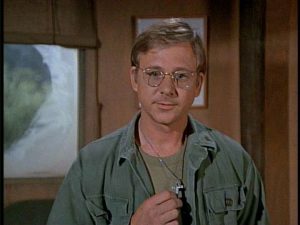
William Christopher as Father Mulcahy
William Christopher (October 20, 1932 – December 31, 2016) was an American actor, best known for playing Father Mulcahy on the television series M*A*S*H and Private Lester Hummel on Gomer Pyle, U.S.M.C.
He guest-starred in several well-known series, including The Andy Griffith Show, Death Valley Days, The Patty Duke Show, The Men from Shiloh and Good Times (he portrayed the military doctor examining J. J. Evans). Christopher had recurring roles on That Girl and Hogan’s Heroes. He made several guest appearances on The Love Boat as well.
Christopher died at his home on December 31, 2016.
Posted in Because I Can, The Little Screen (Television)
In a narrow vote on Wednesday, the BBC reports that a local council in Surrey, England approved plans to redevelop Dunsfold Aerodrome and build 1,800 new homes. That name may sound familiar, because Dunsfold Aerodrome is the site of the test track used by Top Gear.
Guess the BBC doesn’t think much of the new Top Gear either… 🙂
Posted in Because I Can, Planes Trains and Automobiles
Posted in Because I Can
Posted in Because I Can
GREELEY, Colo. – They don’t have much to remember their dad by, except photographs and memories.
Tanner was just 15, when his dad, Weld County Deputy Sam Brownlee, was killed in the line of duty after a police chase in 2010.
Nearly five years later, Tanner and his brother, Chase, were hoping to get one of their dad’s prized possessions from the Weld County Sheriff’s Office.
“It’d mean a lot to me and my brother. We’ve been through a lot,” said Tanner.
The Weld County Sheriff’s Office auctioned off their dad’s Dodge Charger on Wednesday night. The vehicle, with 147,000 miles, was being sold to raise money for C.O.P.S. — Concerns of Police Survivors, an organization that provides services for survivors of law enforcement officers killed in the line of duty.
“If we do get it tonight, I kind of hope my mom will let me drive it around tonight,” Tanner said before the auction.
“This is kind of the end of Sam’s legacy here. It’s the last tangible thing we have that he was connected to,” said Weld County Sheriff Steve Reams.
Tanner started a GoFundMe page to raise money to bid on the squad car. It was just more than $3,000 when the auction started. He didn’t reveal how much he had to spend, but he had a plan.
“I think I’m just going to look around, see what everyone else is doing and try to copy them,” said Tanner. “Just up them by one.”
When the auction started, Tanner bid first at $2,500. Within minutes, the bids were beyond the Kelly Blue Book value of $12,500.
“I think if it goes past the limit we have, I just have to hope that someone has it in their heart to win the car and give it to me and my brother. We don’t really have a backup plan,” said Tanner.
As the bids reached $50,000, Tanner’s limit had clearly come and gone, just like his dad’s car.
“60! Sold it your way, Mr. Steve Wells. Thank you very much,” said the auctioneer.
The car sold for $60,000 to a local rancher. Tanner didn’t know Wells before Wednesday, but won’t be able to forget him now.
As soon as the auctioneer handed Wells the keys, he turned to Tanner.
“Tanner, here’s your car,” said Wells.
“You had no idea that that guy in the back was bidding and was going to hand you the keys?” asked 7NEWS reporter Marshall Zelinger.
“Nope. I shook his hand and I didn’t know,” said Tanner. “It means so much to me.”
Tanner told the Sheriff he was going to donate the money from his GoFundMe account to C.O.P.S.
7NEWS spoke with Wells after the auction. He considered an interview for a moment, but then saw Tanner get behind the wheel of his new car and said he didn’t want to take away from that moment.
EDIT: Added video
Posted in Because I Can
For my Democratic Friends:
“Please accept with no obligation, implied or implicit, our best wishes for an environmentally conscious, socially responsible, low-stress, non-addictive, gender-neutral celebration of the winter solstice holiday, practiced within the most enjoyable traditions of the religious persuasion of your choice, or secular practices of your choice, with respect for the religious/secular persuasion and/or traditions of others, or their choice not to practice religious or secular traditions at all. We also wish you a fiscally successful, personally fulfilling and medically uncomplicated recognition of the onset of the generally accepted new calendar year, but not without due respect for the calendars of choice of other cultures whose contributions to society have helped make America great. Not to imply that America is necessarily greater than any other country nor the only America in the Western Hemisphere. And without regard to the race, creed, color, age, physical ability, religious faith or sexual preference of the wishee. By accepting these greetings you are accepting these terms. This greeting is subject to clarification or withdrawal. It is freely transferable with no alteration to the original greeting. It implies no promise by the wisher to actually implement any of the wishes for herself or himself or others, and is void where prohibited by law and is revocable at the sole discretion of the wisher. This wish is warranted to perform as expected within the usual application of good tidings for a period of one year or until the issuance of a subsequent holiday greeting, whichever comes first, and warranty is limited to replacement of this wish or issuance of a new wish at the sole discretion of the wisher.”
For my Republican Friends:
Here’s wishing all of You a Merry Christmas and a Happy New Year !!!!!!!
Posted in Because I Can
In 1970, a plane got fed up with its pilot so it hatched an audacious plan. First, get rid of the pilot. Second: land. Third: enter history. The result was amazing.
On February 2, 1970 four pilots of the 71st Fighter-Interceptor Squadron were to take off from the Malmstrom Air Force Base in Montana. They were to do so on Convair F-106A-100-CO Delta Darts and engage in mock combat.
But one plane had ideas of its own. Just as it was about to take off, its drag chute deployed – forcing its pilot to abort.
So then there were three. Major Tom Curtis was to “fight” Major Jim Lowe and Captain Gary Faust. No problem – they’d been through this before. Or so they thought.
The three split up to begin their dogfight. Once they were 20 miles apart, ground controllers gave them all different vectors to ensure that each had a fair chance. From that point on, they could do whatever they felt was necessary to win.
Curtis went after Faust first, so he accelerated to Mach 1.90. The plan was to force Faust into a vertical engagement that would put him at a disadvantage.
The three planes zoomed toward each other and overshot. Curtis climbed, forcing the other two to try and catch up. Having entered the climb faster, he had the advantage, but it couldn’t last.
So he switched to vertical scissors – using his speed to climb and dive in a spiral while doing a barrel roll. He then took it a step further by widening his spirals, forcing the other two to break out of their own climb.
Once past 38,000 feet, Curtis did a high-G rudder reversal – turning and rolling to reduce his thrust, thereby forcing his “enemy” to overshoot him. It worked… sort of. Faust took the bait, which probably annoyed his plane.
Tail number 58-0787 shuddered, then went into an accelerated stall – meaning it suddenly plunked its nose downward. Then it made a beeline toward the ground.
Curtis saw it all. From his angle, it looked as if the plane’s tail was doing a slow circuit around its wobbling nose – disaster! It’s called a flat spin. And once an F-106A does that, it’s almost as good as dead.
Fortunately, the men were seasoned, professional pilots. Lowe’s calm voice came over Faust’s radio – carefully going over spin recovery procedures step-by-step. Faust followed them all faithfully, trying to maneuver the plane’s nose at an angle that would break its spin.
He set the plane’s trim to the take-off position, but 58-0787 refused to respond. Trimming frees the pilot from having to exert constant pressure on the controls, but it did no good. Nothing worked.
There was only one thing left to do – activate the drag chute. This wasn’t meant to be used in flight, however. It’s only for extra braking when a plane lands. The hope was that it would slow the plane down enough so Faust could get it at the angle needed to break its spin.
So he deployed it, and off it went… wrapping itself around 58-0787’s vertical stabilizer. Perhaps even more annoyed by that, the F-106A continued its downward spiral of doom. Faust had exhausted all of his options.
And having fallen below the 15,000 feet mark, he had also run out of time. If he was to survive, he had to bail – so he did.
It was the signal that 58-0787 was waiting for. The blast that catapulted Faust out was exactly what was needed to push its nose straight down.
The plane broke out of its spin, leveled off, and resumed flying in a straight line – albeit with a slight left and right wobbling. Even better, Faust had set the trim to take-off, which was similar to the landing trim position. And best of all, he had moved the throttle to “idle” – putting the plane into a steady gliding descent.
Except that he was no longer in it. Lowe saw it all and couldn’t help laughing, “Gary? You better get back into that thing!”
But 58-0787 was having none of it. Freed of its human, at last, it flew off into the vast blue skies above northern Montana. Faust, meanwhile, could only watch in awe as his plane continued to fly on without him as he slowly parachuted down into the snow-covered Bear Paw Mountains.
Curtis and Lowe radioed his position and headed back to base. All three hoped that wherever 58-0787 crashed, it wouldn’t be on anyone below. As for Faust, he was rescued shortly after landing by a group of Native Americans on snowmobiles.
But 58-0787 had no intention of crashing. Traveling at about 175 knots, it reveled in its new-found freedom till it reached the town of Big Sandy (population: 598 in 2010) in Chouteau County. Seeing a lovely snow-covered alfalfa field, it made a slow, steady downward glide till it touched ground.
Delighted by the snow, it continued to slide, making sure to stay steady and avoid letting either wing touch the earth. But there was trouble ahead. Cutting across the field at an angle to its approach lay a low, stone wall with only a narrow gap in the middle.
So 58-0787 slid to the right, did a 20° turn, slipped through the opening, and continued on into the next field where it finally stopped before an astonished farmer. The man called the sheriff, of course, who called the base.
They asked him to assess the damage, but each time he tried to get close, 58-0787 would jiggle and dance, trying to get away. Finally, the authorities told him to just let the thing be – it would run out of fuel, eventually.
By the time the military got there, it had done just that – almost two hours later. So they took off its wings and hauled it back to base. To their surprise, except for some superficial scratches on its underside, it was still flight-worthy and later put back in active service.
They called Faust the “Cornfield Bomber” after that, but he was not a bomber. Nor did 58-0787 land in a cornfield. It now rests at the National Museum of the US Air Force, restored to its former glory, and no doubt reminiscing about its Montana adventure.
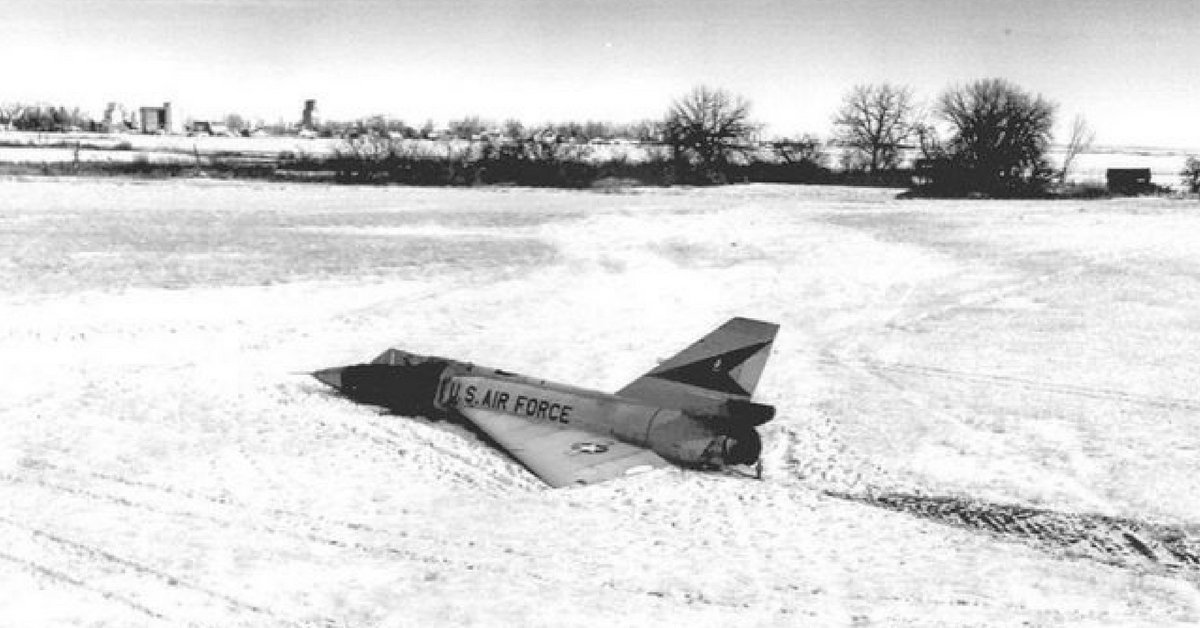
58-0787 resting on an alfalfa field in Montana
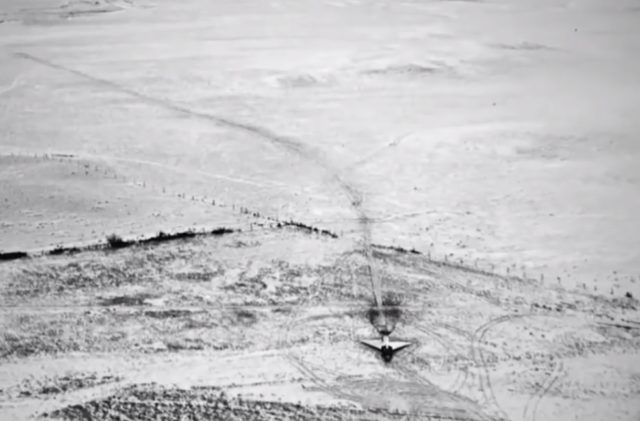
58-0787 after making a right turn to avoid the stone wall
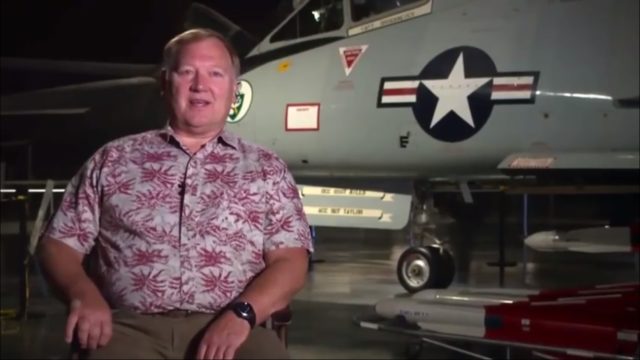
Major Gary Foust (retired) with 58-0787 (also retired) behind him
Posted in Because I Can, Humor, Planes Trains and Automobiles
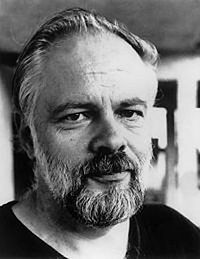
Philip K. Dick (December 16, 1928 – March 2, 1982)
Philip Kindred Dick was an American science fiction novelist and short story writer. He often drew upon his own life experiences and addressed the nature of drug use, paranoia and schizophrenia, and mystical experiences in novels such as A Scanner Darkly and VALIS.
In addition to his novels, Dick wrote approximately 121 short stories, many of which appeared in science fiction magazines. Although Dick spent most of his career as a writer in near-poverty, nine of his stories have been adapted into popular films since his death, including Blade Runner, Total Recall, A Scanner Darkly and Minority Report. In 2005, Time Magazine named Ubik one of the one hundred greatest English-language novels published since 1923. In 2007, Dick became the first science fiction writer to be included in The Library of America series.
Posted in Because I Can, Literary, The Big Screen
Sir Arthur Charles Clarke, (December 16, 1917 – March 19, 2008) was a British science fiction author, inventor, and futurist, most famous for his novel 2001: A Space Odyssey, and for collaborating with director Stanley Kubrick on the film of the same name.
Posted in Because I Can, Literary
Walter Elias Disney was an American film producer, director, screenwriter, voice actor, animator, entrepreneur, visionary, and philanthropist. He was the son of Flora and Elias Disney, and had three brothers and one sister. As the co-founder (with his brother Roy O. Disney) of Walt Disney Productions, Walt became one of the best-known motion picture producers in the world.
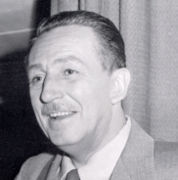
Walt Disney (December 5, 1901 – December 15, 1966)