Category Archives: Because I Can

Birth of the Mustang (and the Pony Car)

April 17, 1964: Ford Mustang Starts Galloping

1964: Ford introduces the Mustang at the New York World’s Fair. It becomes an instant hit and an icon that alters the automotive landscape, giving rise to one of the most successful — and most uniquely American — automobile genres: the pony car.

The Ford Mustang was born of the simple idea that putting a back seat in a sports car would be a great idea.

The idea came to Lee Iacocca and Donald Frey in the early 1960s as the country was being overrun by European sports cars. Everywhere you looked you saw Alfa Romeos and MGs and Triumphs that dripped oil. Even French cars that would draw peals of laughter today were popular back then.

The two Ford execs saw a vast market literally rolling before their eyes, and, according to legend, the notion of a sports car with a back seat was one of those “ah-hah” moments. If Ford could dilute the European ethos just a bit by making the cars a bit more practical and a lot more affordable, Iacocca figured, the company would sell a few thousand.

He was right, but boy was he wrong. Ford didn’t sell thousands of them. It sold millions of them.

They sold 22,000 on the first day.

The Mustang was more than a success. It was a phenomenon. Ford sold 1 million in the first 18 months, making the Mustang its most successful launch since the Model A.

The pony car is easy to define. It was small by Detroit standards, with sporty styling. It had a back seat for your kids and a usable trunk for your stuff. And the rear wheels were driven by an engine — ideally a big V-8 — mounted up front where God and Henry Ford intended.

Pony cars may not have had the finesse of a European sports car, but they made up for it with brute force. A small-block V-8 can make up for a multitude of handling deficiencies.

The Mustang was successful like the Beatles were popular. Ford figured it would sell around 100,000 in the first 12 months of production. It sold 10 times that number in the first 18.

That success was not lost on the rest of Detroit, and everyone was cranking out pony cars by 1967. General Motors introduced the Chevrolet Camaro and its kissing cousin, the Pontiac Firebird. Ford offered the more upscale Mercury Cougar. Chrysler released the Challenger. Even AMC — google it, we’ll wait — got into the act with the Javelin.

Everyone had a favorite, and even now loyalists occasionally come to blows over which one was best. Countless bets have been made and races staged in displays of testosterone and bravado that would make Dr. Freud sit down for a cigar and a good long think.

And that was just in the parking lots and streets. Things really got wild when the automakers got in on the act, bringing in drivers like Dan Gurney and George Follmer and Mark Donohue to show who built the best car. The contest grew so heated it gave rise to a pony-car–specific racing series called Trans Am. (The car was named after the series, not the other way around.)

We’re inclined to give the award to the Mustang, if only because Steve McQueen drove a ’68 fastback in the most famous chase scene in cinematic history, that amazing dash through the streets of San Francisco in Bullitt.

The Mustang also gets the nod for sheer longevity. Oh sure, you can get a new Camaro that looks like a vintage Camaro, or a new Dodge Challenger that looks like a vintage Dodge Challenger.

But the Mustang is the only pony car to remain in continuous production since its introduction 45 years ago.

Ford has sold more than 9 million worldwide.
Houston, We’ve Had A Problem…

April 17th, 1970 the capsule from the Apollo 13 mission splashed down in the Pacific Ocean, and the whole world breathed a sigh of relief.

Quote


Apollo 13 launched from Cape Canaveral on April 11, intended to be the third manned lunar landing. The crew — James A. Lovell Jr., John L. Swigert Jr. and Fred W. Haise Jr. — experienced a slight vibration shortly after launch, but things were going normally until 55 hours, 55 minutes into the flight.

Oxygen tank No. 2 exploded, causing No. 1 to fail and start leaking rapidly. Warning lights started blinking. The astronaut’s supplies of air, water, light and electricity were imperiled … 200,000 miles from Earth.


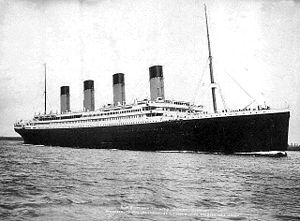
Anniversary of the sinking of the Titanic

Titanic

RMS Titanic departing Southampton on 10 April 1912

On April 15th, 1912, RMS Titanic struck an iceberg on her maiden voyage from Southampton, England to New York City and sank, taking over 1500 lives with her.

Wikipedia Link

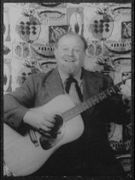
RIP Burle Ives

Burl Icle Ivanhoe Ives was an acclaimed American folk music singer, author and actor.

Possibly his most remembered role today is as narrator Sam the Snowman in the Rankin-Bass animated television special, Rudolph the Red-Nosed Reindeer (1964).

Ives’s “A Holly Jolly Christmas” is a very popular tune during the Christmas season, as it’s frequently played on the radio and was featured in the Rudolph the Red-Nosed Reindeer special.

Burl Ives

Burl Icle Ivanhoe Ives (14 June 1909 – 14 April 1995)

RIP Don Ho… No More “Tiny Bubbles”

Don Ho, born Donald Tai Loy Ho (August 13, 1930 – April 14, 2007) was a Hawaiian musician and entertainer. He was best known for his song, “Tiny Bubbles.”

Wikipedia Link

Abraham Lincoln Assassinated

On this day in 1865, John Wilkes Booth, an actor and Confederate sympathizer, fatally shoots President Abraham Lincoln at a play at Ford’s Theater in Washington, D.C. The attack came only five days after Confederate General Robert E. Lee surrendered his massive army at Appomattox Court House, Virginia, effectively ending the American Civil War.

Booth, a Maryland native born in 1838, who remained in the North during the war despite his Confederate sympathies, initially plotted to capture President Lincoln and take him to Richmond, the Confederate capital. However, on March 20, 1865, the day of the planned kidnapping, the president failed to appear at the spot where Booth and his six fellow conspirators lay in wait. Two weeks later, Richmond fell to Union forces. In April, with Confederate armies near collapse across the South, Booth hatched a desperate plan to save the Confederacy.

Learning that Lincoln was to attend a performance of “Our American Cousin” at Ford’s Theater on April 14, Booth masterminded the simultaneous assassination of Lincoln, Vice President Andrew Johnson and Secretary of State William H. Seward. By murdering the president and two of his possible successors, Booth and his conspirators hoped to throw the U.S. government into disarray.

On the evening of April 14, 1865, conspirator Lewis T. Powell burst into Secretary of State Seward’s home, seriously wounding him and three others, while George A. Atzerodt, assigned to Vice President Johnson, lost his nerve and fled. Meanwhile, just after 10 p.m., Booth entered Lincoln’s private theater box unnoticed and shot the president with a single bullet in the back of his head. Slashing an army officer who rushed at him, Booth leapt to the stage and shouted “Sic semper tyrannis! [Thus always to tyrants]–the South is avenged!” Although Booth broke his leg jumping from Lincoln’s box, he managed to escape Washington on horseback.

The president, mortally wounded, was carried to a lodging house opposite Ford’s Theater. About 7:22 a.m. the next morning, Lincoln, age 56, died–the first U.S. president to be assassinated. Booth, pursued by the army and other secret forces, was finally cornered in a barn near Bowling Green, Virginia, and died from a possibly self-inflicted bullet wound as the barn was burned to the ground. Of the eight other people eventually charged with the conspiracy, four were hanged and four were jailed.

Mercury 7

Mercury 7

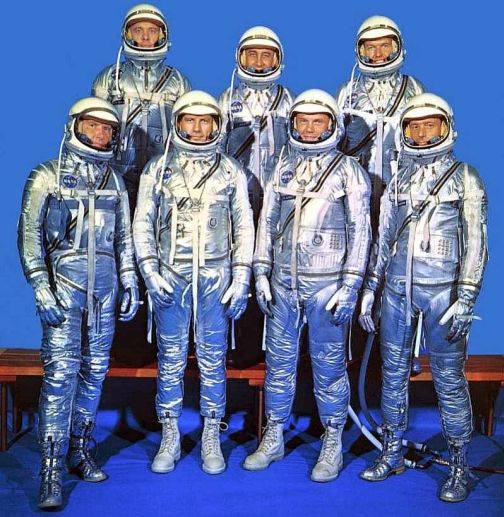
On this day in 1959, NASA announced The Mercury Seven: the seven men to make up their first astronaut class.

The Mercury Seven were chosen in Washington, DC from a body of 69 candidates. The name comes from Mercury, a Roman mythological god who is seen as a symbol of speed. Because of the small space inside the Mercury capsule, candidates could be no taller than 5 feet 11 inches and weigh no more than 180 pounds. The initial flights took off throughout the early 1960s, though some astronauts were active in later decades. Here are the guys:

Malcolm Scott Carpenter (born 1925) was a US Navy piolot aviation cadet who flew missions during the Korean War. He was on board the MA-7 (Aurora 7) and was the first American astronaut to eat solid food in space. He successfully overcame an overexpenditure of fuel due to hardware problems on his one and only mission. Carpenter was forced to retire from spaceflight after sustaining a motorbike accident. After retiring from the Navy, he founded Sea Sciences Inc., a corporation for developing programs for utilizing ocean resources and improving environmental health.

Leroy Gordon (Gordo) Cooper Jr. (1927 – 2004) was very active in the Boy Scouts of America and achieved the second highest rank of Life Scout. Prior to joining NASA, Cooper also served in the US Air Force and Marine Corps. He was on board the MA-9 (Faith 7) and Gemini 5, and developed a personal survival knife for astronauts to carry. Cooper was the first American to sleep in orbit. Interestingly, he took photos of and reported UFO sightings to the Pentagon, but they swept the incident under the rug.

John Herschel Glenn Jr. (born 1921) began his career as a US Marine Corps fighter pilot. He was on board the MA-6 (Friendship 7) and STS-95. Noticed for his heroics in space, Glenn became friendly with the Kennedys and a prominent public figure. After retiring from NASA, he ran as a Democrat and represented the state of Ohio in the United States Senate from 1974 to 1999.

Virgil Ivan (Gus) Grissom (1926 – 1967) was a US Air Force pilot before joining NASA. He was on board the MR-4 (Liberty Bell 7), Gemini 3, and Apollo 1. Grissom was tragically killed along with fellow astronauts Ed White and Roger Chaffee during a pre-launch test for the Apollo 1 mission. After death, his family was involved in a spacesuit controversy: NASA insisted Grissom got authorization to use his spacesuit for a show and tell at his son’s school and never returned it, but his family claimed the he had rescued the spacesuit from a scrap heap and that it rightfully belonged to them.

Walter Marty (Wally) Schirra Jr. (1923 – 2007)’s father was a pilot, and his mother performed wing walking stunts when he was on duty. Schirra served as an officer in the US Navy, and was later dispatched to South Korea as a pilot on loan to the US Air Force. On board the MA-8 (Sigma 7), Gemini 6A, and Apollo 7, he was the only person to fly in all of America’s first three space programs. Schirra gained notoriety for playing “Jingle Bells” on a harmonica he smuggled on board Gemini.

Alan Bartlett Shepard Jr. (1923 – 1998) began as a US Navy as test pilot. He was the first American in space, and flew on board the MR-3 (Freedom 7) and Apollo 14. It’s said that shortly before one launch, Shepard blurted out “Please, dear God, don’t let me fuck up.” This has since become known among aviators as “Shepard’s Prayer.” A successful businessman, Shepard was the first astronaut to become a millionaire while still in the program. His hometown of Derry, NH almost changed its name to “Spacetown” in honor of Schirra’s career.

Donald Kent (Deke) Slayton (1924 – 1993) was also a US Air Force pilot before joining NASA. He was grounded from space flight by a heart condition, but served as NASA’s Director of Flight Crew Operations. Slayton served as head of Astronaut selection. In 1972 he was granted medical clearance to fly as docking module pilot of the Apollo-Soyuz Test Project. At the time of the flight, he became the oldest person to fly into space.

The last surviving members of the Mercury Seven, as of April 7, 2012, are Glenn and Scott Carpenter.

RIP Johnny Hart

RIP Johnny Hart

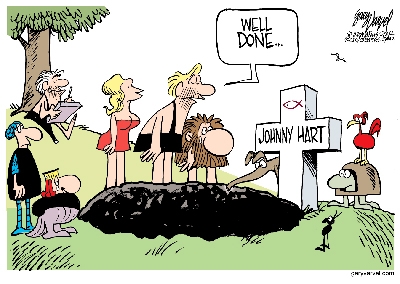
Johnny Hart (February 18, 1931 – April 7, 2007) was an American cartoonist noted as the creator of the comic strip B.C. and co-creator of the strip The Wizard of Id.

RIP Isaac Asimov

Isaac Asimov

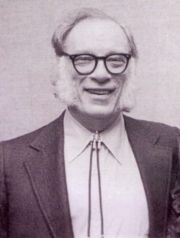
Isaac Asimov (c. January 2, 1920 – April 6, 1992)

 Wikipedia Link

Dr. Isaac Asimov was a Russian-born American Jewish author and biochemist, a highly successful and exceptionally prolific writer best known for his works of science fiction and for his popular science books. Asimov’s most famous work is the Foundation Series, which was part of one of his two major series, the Galactic Empire Series, later merged with his other famous story arc, the Robot series. He also wrote mysteries and fantasy, as well as a great amount of non-fiction. Asimov wrote or edited more than 500 volumes and an estimated 90,000 letters or postcards, and he has works in every major category of the Dewey Decimal System except Philosophy. Asimov was by consensus a master of the science-fiction genre and, along with Robert A. Heinlein and Arthur C. Clarke, was considered to be one of the “Big Three” science-fiction writers during his lifetime.

Most of Asimov’s popularized science books explain scientific concepts in a historical way, going back as far as possible to a time when the science in question was at its simplest stage. He often gives nationalities, birth dates and death dates for the scientists he mentions, as well as etymologies and pronunciation guides for technical terms.

The Three Laws of Robotics (often shortened to The Three Laws or Three Laws) are a set of rules devised by the science fiction author Isaac Asimov and later added to. The rules were introduced in his 1942 short story “Runaround”, although they were foreshadowed in a few earlier stories. The Three Laws are:

  1. A robot may not injure a human being or, through inaction, allow a human being to come to harm.
  2. A robot must obey the orders given to it by human beings, except where such orders would conflict with the First Law.
  3. A robot must protect its own existence as long as such protection does not conflict with the First or Second Laws.

Happy Keester!

Happy Keester

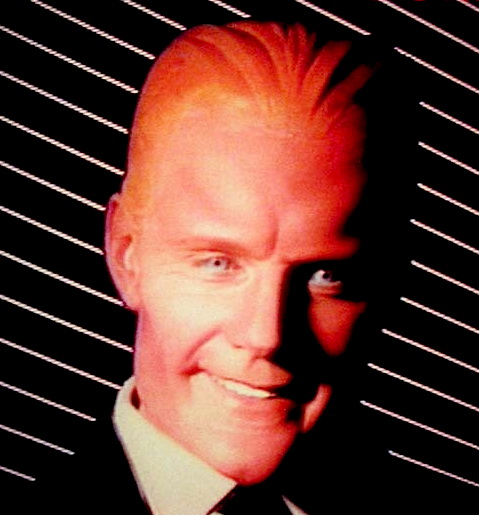
30 Years of Max

On April 4th, 1985, Max was born on British television:

max_headroom

The rest is history…

To “celebrate” the 30th Anniversary of Max Headroom’s 1st TV appearance, Bryan Bishop at the Verge has an awesome article about the show:

Link

Mid-America Truck Show!

2015 Mid-America Trucking Show  |  March 26 – 28, 2015  |  Louisville, KY at the Kentucky Exposition Center

Mid-America Truck Show

Official Site

Ice Meter

ice-meter

American Falls frozen over

American Falls as seen from Niagara Falls, Ontario, Canada, February 19, 2015 (© ZUMA/REX)

American Falls Frozen

Click for larger image


The arctic blast that’s kept much of the northeastern United States buried under snow and ice this winter has caused its share of troubles, but it’s also prompted some incredible natural scenery, such as this view of Niagara Falls partially frozen.

It’s not unusual for portions of Niagara’s American Falls to freeze during the cold winters here at the border between New York and Ontario. In 1909, 1936, 1939, and 1949, the American Falls froze over almost completely, with the running water reduced to a trickle. But it was the March 29, 1848 ice jam on Lake Erie that brought all three of Niagara’s falls (American Falls, Horseshoe Falls, and Bridal Veil Falls) to a strange, silent stop.

Niagara’s winter conditions became more newsworthy this year when two ice climbers used the opportunity to set world records: On January 27, Will Gadd and Sarah Hueniken became the first man and woman to climb the frozen falls. They scaled a wall of ice on the left side of Horseshoe Falls, the largest of Niagara’s three falls.

Mid-America Truck Show!

2015 Mid-America Trucking Show  |  March 26 – 28, 2015  |  Louisville, KY at the Kentucky Exposition Center

Mid-America Truck Show

Official Site

Happy St. Patrick’s Day!

Happy St. Patty’s Day!

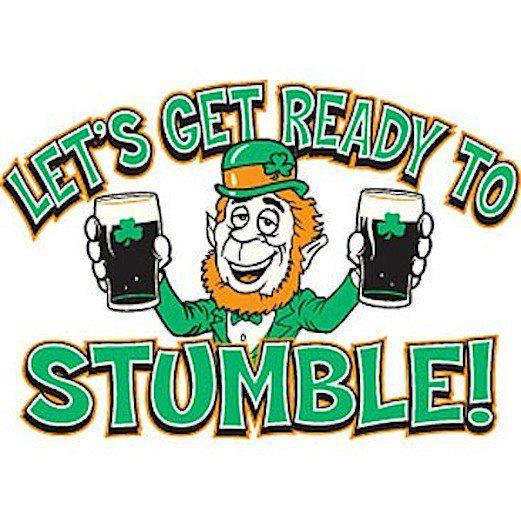
Let's Get Ready to Stumble!

Let’s Get Ready to Stumble!

RIP HP Lovecraft

Howard Phillips Lovecraft (August 20, 1890 – March 15, 1937) was an American author of fantasy, horror and science fiction. Although Lovecraft’s readership was limited during his life, his works sustain cult popularity and influence. He created the Cthulhu Mythos as well as the famed Necronomicon. His profound cosmic pessimism underlies all his works.

Mid-America Truck Show!

2015 Mid-America Trucking Show  |  March 26 – 28, 2015  |  Louisville, KY at the Kentucky Exposition Center

Mid-America Truck Show

Official Site

Happy Birthday, Douglas Adams

Douglas Adams

Douglas Noël Adams (March 11, 1952 – May 11, 2001)

Douglas Adams was an English author, comic radio dramatist, and musician. He is best known as author of the Hitchhiker’s Guide to the Galaxy series. Hitchhiker’s began on radio, and developed into a “trilogy” of five books (which sold more than fifteen million copies during his lifetime) as well as a television series, a towel, a live theater show, a drink, a comic book series, a computer game and a feature film that was completed after Adams’ death. He was known to some fans as Bop Ad (after his illegible signature), or by his initials “DNA”.

Snow Fire

Snow fire