Category Archives: Because I Can

Memorial Day

Flag at Half Mast
Memorial Day

Memorial Day is a United States federal holiday observed on the last Monday of May. Formerly known as Decoration Day, it commemorates U.S. men and women who died while in the military service. First enacted to honor Union soldiers of the American Civil War (it is celebrated near the day of reunification after the civil war), it was expanded after World War I to include American casualties of any war or military action.

It Has Always Been The Soldier

Happy Birthday, Bocephus!

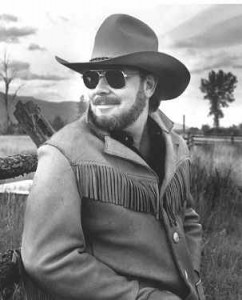
Hank Williams, Jr. is an American country and southern rock artist, son of country music pioneer Hank Williams and father of Hank III and Holly Williams.

Known by the nickname Bocephus (a name given to him by his father because he thought his son as a baby resembled a TV ventriloquist dummy named Bocephus), he was raised by his mother Audrey after his father’s death in 1953. He was destined for fame, being taught how to play piano by Jerry Lee Lewis and guitar by Johnny Cash. He began performing when eight years old.

Hank Williams, Jr.
Hank Williams, Jr. (May 26, 1949 – )

Wikipedia Link

Towel Day

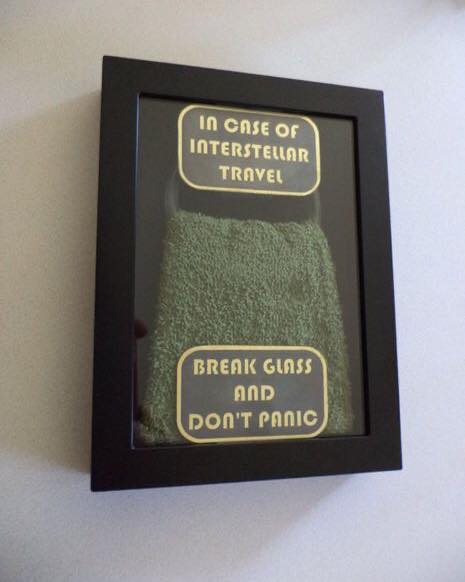
Towel Day

Today is Towel Day, a day of remembrance for Douglas Adams, author of the Hitchhikers’ Guide to the Galaxy. Observe it by carrying a towel all day.

Link

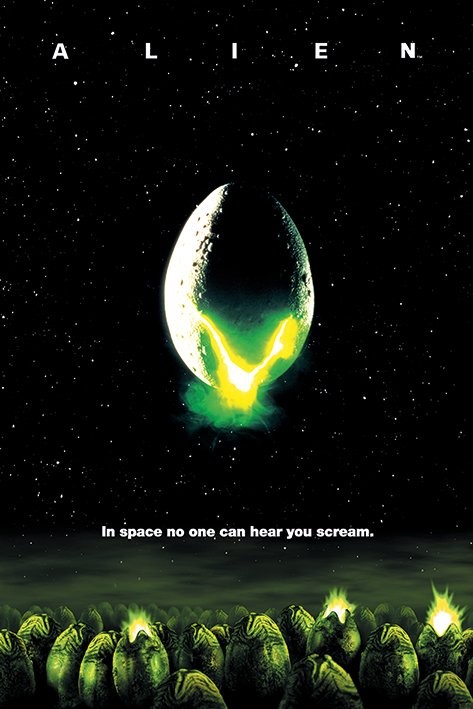
45th Anniversary of Alien!

Alien was released on May 25, 1979 in the United States and September 6 in the United Kingdom. It was met with critical acclaim and box office success, winning the Academy Award for Best Visual Effects, three Saturn Awards (Best Science Fiction Film, Best Direction for Scott, and Best Supporting Actress for Cartwright), and a Hugo Award for Best Dramatic Presentation, along with numerous other nominations. It has been consistently praised in the years since its release, and is considered one of the greatest films of all time. In 2002, Alien was deemed “culturally, historically or aesthetically significant” by the Library of Congress and was selected for preservation in the United States National Film Registry. In 2008, it was ranked by the American Film Institute as the seventh-best film in the science fiction genre, and as the thirty-third greatest film of all time by Empire magazine.

The success of Alien spawned a media franchise of films, novels, comic books, video games, and toys. It also launched Weaver’s acting career, providing her with her first lead role. The story of her character’s encounters with the Alien creatures became the thematic and narrative core of several sequels, prequels, and crossovers.

Wikipedia Link

Anniversary of Star Wars

Star Wars

May 25, 1977, Memorial Day weekend opens with an intergalactic bang as the first of George Lucas’ blockbuster Star Wars movies hits American theaters.

Wikipedia Link

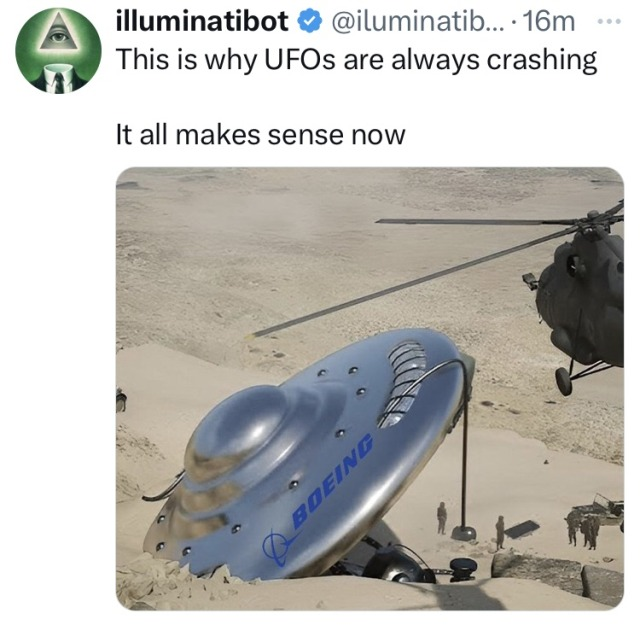
It all makes sense now!

Transformers – 1950’s Super Panavision 70

Full clip of ‘Biden Tic Tacs’

Biden Tic-Tacs!!!!

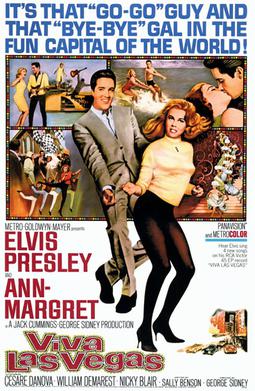
60th Anniversary of Viva Las Vegas

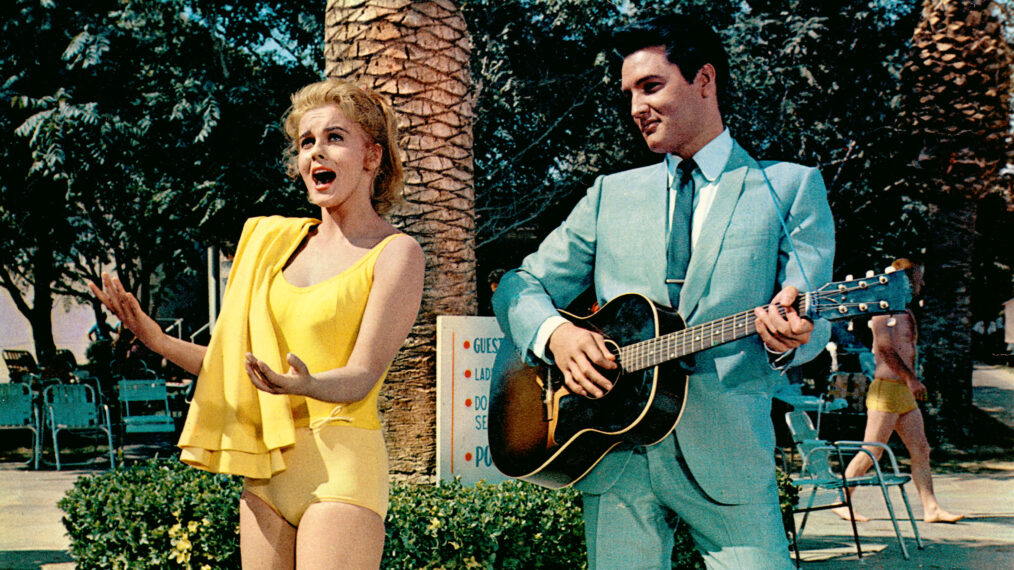
Viva Las Vegas is a 1964 American rock and roll musical film directed by George Sidney, choreographed by David Winters, and starring Elvis Presley, Ann-Margret, Cesare Danova, William Demarest. Set in Las Vegas, Nevada, the film is about two competing race car drivers who also compete for the same girl.

Wikipedia Link

Happy Mother’s Day

Happy Mother's Day

Being a Mother

Somebody…

The Zip Tie Story

Why ZZ Top Grew Out Their Beards

Happy Birthday, Sir David Attenborough

Sir David Attenborough (May 8th 1926 - )
Sir David Attenborough (May 8th 1926 – )

Wikipedia Article

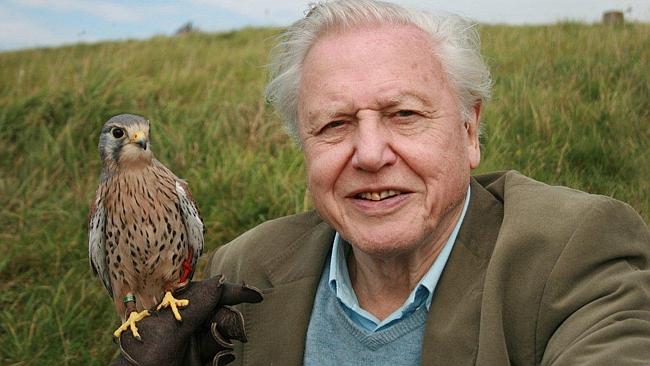
Sir David Frederick Attenborough is an English broadcaster and naturalist.

He is best known for writing and presenting the nine Life series, in conjunction with the BBC Natural History Unit, which collectively form a comprehensive survey of animal and plant life on the planet. He is also a former senior manager at the BBC, having served as controller of BBC Two and director of programming for BBC Television in the 1960s and 1970s. He is the only person to have won BAFTAs for programs in each of black and white, colour, HD, and 3D.

Attenborough is widely considered a national treasure in Britain, although he himself does not like the term. In 2002 he was named among the 100 Greatest Britons following a UK-wide vote. He is the younger brother of director, producer and actor Richard Attenborough.

1961 : The first American in space

From Cape Canaveral, Florida, Navy Commander Alan Bartlett Shepard Jr. is launched into space aboard the Freedom 7 space capsule, becoming the first American astronaut to travel into space. The suborbital flight, which lasted 15 minutes and reached a height of 116 miles into the atmosphere, was a major triumph for the National Aeronautics and Space Administration (NASA).

NASA was established in 1958 to keep U.S. space efforts abreast of recent Soviet achievements, such as the launching of the world’s first artificial satellite–Sputnik 1–in 1957. In the late 1950s and early 1960s, the two superpowers raced to become the first country to put a man in space and return him to Earth. On April 12, 1961, the Soviet space program won the race when cosmonaut Yuri Gagarin was launched into space, put in orbit around the planet, and safely returned to Earth. One month later, Shepard’s suborbital flight restored faith in the U.S. space program.

NASA continued to trail the Soviets closely until the late 1960s and the successes of the Apollo lunar program. In July 1969, the Americans took a giant leap forward with Apollo 11, a three-stage spacecraft that took U.S. astronauts to the surface of the moon and returned them to Earth. On February 5, 1971, Alan Shepard, the first American in space, became the fifth astronaut to walk on the moon as part of the Apollo 14 lunar landing mission.

May the 4th Be With You

May the 4th

Nuclear Disaster at Chernobyl

On April 26, 1986, the world’s worst nuclear power plant accident occurs at the Chernobyl nuclear power station in the Soviet Union. Thirty-two people died and dozens more suffered radiation burns in the opening days of the crisis, but only after Swedish authorities reported the fallout did Soviet authorities reluctantly admit that an accident had occurred.

The Chernobyl station was situated at the settlement of Pripyat, about 65 miles north of Kiev in the Ukraine. Built in the late 1970s on the banks of the Pripyat River, Chernobyl had four reactors, each capable of producing 1,000 megawatts of electric power. On the evening of April 25, 1986, a group of engineers began an electrical-engineering experiment on the Number 4 reactor. The engineers, who had little knowledge of reactor physics, wanted to see if the reactor’s turbine could run emergency water pumps on inertial power.

As part of their poorly designed experiment, the engineers disconnected the reactor’s emergency safety systems and its power-regulating system. Next, they compounded this recklessness with a series of mistakes: They ran the reactor at a power level so low that the reaction became unstable, and then removed too many of the reactor’s control rods in an attempt to power it up again. The reactor’s output rose to more than 200 megawatts but was proving increasingly difficult to control. Nevertheless, at 1:23 a.m. on April 26, the engineers continued with their experiment and shut down the turbine engine to see if its inertial spinning would power the reactor’s water pumps. In fact, it did not adequately power the water pumps, and without cooling water the power level in the reactor surged.

To prevent meltdown, the operators reinserted all the 200-some control rods into the reactor at once. The control rods were meant to reduce the reaction but had a design flaw: graphite tips. So, before the control rod’s five meters of absorbent material could penetrate the core, 200 graphite tips simultaneously entered, thus facilitating the reaction and causing an explosion that blew off the heavy steel and concrete lid of the reactor. It was not a nuclear explosion, as nuclear power plants are incapable of producing such a reaction, but was chemical, driven by the ignition of gases and steam that were generated by the runaway reaction. In the explosion and ensuing fire, more than 50 tons of radioactive material were released into the atmosphere, where it was carried by air currents.

On April 27, Soviet authorities began an evacuation of the 30,000 inhabitants of Pripyat. A cover-up was attempted, but on April 28 Swedish radiation monitoring stations, more than 800 miles to the northwest of Chernobyl, reported radiation levels 40 percent higher than normal. Later that day, the Soviet news agency acknowledged that a major nuclear accident had occurred at Chernobyl.

In the opening days of the crisis, 32 people died at Chernobyl and dozens more suffered radiation burns. The radiation that escaped into the atmosphere, which was several times that produced by the atomic bombs dropped on Hiroshima and Nagasaki, was spread by the wind over Northern and Eastern Europe, contaminating millions of acres of forest and farmland. An estimated 5,000 Soviet citizens eventually died from cancer and other radiation-induced illnesses caused by their exposure to the Chernobyl radiation, and millions more had their health adversely affected. In 2000, the last working reactors at Chernobyl were shut down and the plant was officially closed.

How Alcatraz Became an Island Prison

Houston, We’ve Had A Problem…

April 17th, 1970 the capsule from the Apollo 13 mission splashed down in the Pacific Ocean, and the whole world breathed a sigh of relief.

Quote


Apollo 13 launched from Cape Canaveral on April 11, intended to be the third manned lunar landing. The crew — James A. Lovell Jr., John L. Swigert Jr. and Fred W. Haise Jr. — experienced a slight vibration shortly after launch, but things were going normally until 55 hours, 55 minutes into the flight.

Oxygen tank No. 2 exploded, causing No. 1 to fail and start leaking rapidly. Warning lights started blinking. The astronaut’s supplies of air, water, light and electricity were imperiled … 200,000 miles from Earth.


Birth of the Mustang (and the Pony Car)

April 17, 1964: Ford introduces the Mustang at the New York World’s Fair. It becomes an instant hit and an icon that alters the automotive landscape, giving rise to one of the most successful — and most uniquely American — automobile genres: the pony car.

The Ford Mustang was born of the simple idea that putting a back seat in a sports car would be a great idea.

The idea came to Lee Iacocca and Donald Frey in the early 1960s as the country was being overrun by European sports cars. Everywhere you looked you saw Alfa Romeos and MGs and Triumphs that dripped oil. Even French cars that would draw peals of laughter today were popular back then.

The two Ford execs saw a vast market literally rolling before their eyes, and, according to legend, the notion of a sports car with a back seat was one of those “ah-hah” moments. If Ford could dilute the European ethos just a bit by making the cars a bit more practical and a lot more affordable, Iacocca figured, the company would sell a few thousand.

He was right, but boy was he wrong. Ford didn’t sell thousands of them. It sold millions of them.

They sold 22,000 on the first day.

The Mustang was more than a success. It was a phenomenon. Ford sold 1 million in the first 18 months, making the Mustang its most successful launch since the Model A.

The pony car is easy to define. It was small by Detroit standards, with sporty styling. It had a back seat for your kids and a usable trunk for your stuff. And the rear wheels were driven by an engine — ideally a big V-8 — mounted up front where God and Henry Ford intended.

Pony cars may not have had the finesse of a European sports car, but they made up for it with brute force. A small-block V-8 can make up for a multitude of handling deficiencies.

The Mustang was successful like the Beatles were popular. Ford figured it would sell around 100,000 in the first 12 months of production. It sold 10 times that number in the first 18.

That success was not lost on the rest of Detroit, and everyone was cranking out pony cars by 1967. General Motors introduced the Chevrolet Camaro and its kissing cousin, the Pontiac Firebird. Ford offered the more upscale Mercury Cougar. Chrysler released the Challenger. Even AMC — google it, we’ll wait — got into the act with the Javelin.

Everyone had a favorite, and even now loyalists occasionally come to blows over which one was best. Countless bets have been made and races staged in displays of testosterone and bravado that would make Dr. Freud sit down for a cigar and a good long think.

And that was just in the parking lots and streets. Things really got wild when the automakers got in on the act, bringing in drivers like Dan Gurney and George Follmer and Mark Donohue to show who built the best car. The contest grew so heated it gave rise to a pony-car–specific racing series called Trans Am. (The car was named after the series, not the other way around.)

We’re inclined to give the award to the Mustang, if only because Steve McQueen drove a ’68 fastback in the most famous chase scene in cinematic history, that amazing dash through the streets of San Francisco in Bullitt.

The Mustang also gets the nod for sheer longevity. Oh sure, you can get a new Camaro that looks like a vintage Camaro, or a new Dodge Challenger that looks like a vintage Dodge Challenger.

But the Mustang is the only pony car to remain in continuous production since its introduction 45 years ago.

Ford has sold more than 9 million worldwide.