Category Archives: Patriotic

Abraham Lincoln Assassinated

On this day in 1865, John Wilkes Booth, an actor and Confederate sympathizer, fatally shoots President Abraham Lincoln at a play at Ford’s Theater in Washington, D.C. The attack came only five days after Confederate General Robert E. Lee surrendered his massive army at Appomattox Court House, Virginia, effectively ending the American Civil War.

Booth, a Maryland native born in 1838, who remained in the North during the war despite his Confederate sympathies, initially plotted to capture President Lincoln and take him to Richmond, the Confederate capital. However, on March 20, 1865, the day of the planned kidnapping, the president failed to appear at the spot where Booth and his six fellow conspirators lay in wait. Two weeks later, Richmond fell to Union forces. In April, with Confederate armies near collapse across the South, Booth hatched a desperate plan to save the Confederacy.

Learning that Lincoln was to attend a performance of “Our American Cousin” at Ford’s Theater on April 14, Booth masterminded the simultaneous assassination of Lincoln, Vice President Andrew Johnson and Secretary of State William H. Seward. By murdering the president and two of his possible successors, Booth and his conspirators hoped to throw the U.S. government into disarray.

On the evening of April 14, 1865, conspirator Lewis T. Powell burst into Secretary of State Seward’s home, seriously wounding him and three others, while George A. Atzerodt, assigned to Vice President Johnson, lost his nerve and fled. Meanwhile, just after 10 p.m., Booth entered Lincoln’s private theater box unnoticed and shot the president with a single bullet in the back of his head. Slashing an army officer who rushed at him, Booth leapt to the stage and shouted “Sic semper tyrannis! [Thus always to tyrants]–the South is avenged!” Although Booth broke his leg jumping from Lincoln’s box, he managed to escape Washington on horseback.

The president, mortally wounded, was carried to a lodging house opposite Ford’s Theater. About 7:22 a.m. the next morning, Lincoln, age 56, died–the first U.S. president to be assassinated. Booth, pursued by the army and other secret forces, was finally cornered in a barn near Bowling Green, Virginia, and died from a possibly self-inflicted bullet wound as the barn was burned to the ground. Of the eight other people eventually charged with the conspiracy, four were hanged and four were jailed.
RIP Margaret Thatcher


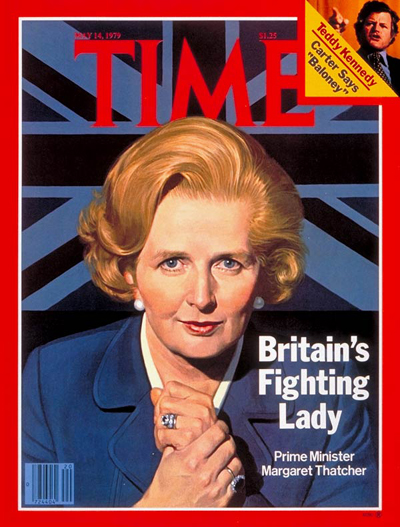
Margaret Thatcher (October 13,1925 – April 8, 2013

Margaret Thatcher (October 13,1925 – April 8, 2013

Margaret Hilda Thatcher, Baroness Thatcher was a British Conservative Party politician who was the Prime Minister of the United Kingdom from 1979 to 1990 and the Leader of the Conservative Party from 1975 to 1990. She was the longest-serving British Prime Minister of the 20th Century, and is to date the only woman to have held the post. A Soviet journalist called her the “Iron Lady“, a nickname which became associated with her uncompromising politics and leadership style. As Prime Minister, she implemented policies that have come to be known as Thatcherism.

Wikipedia Link

Mercury 7

Mercury 7

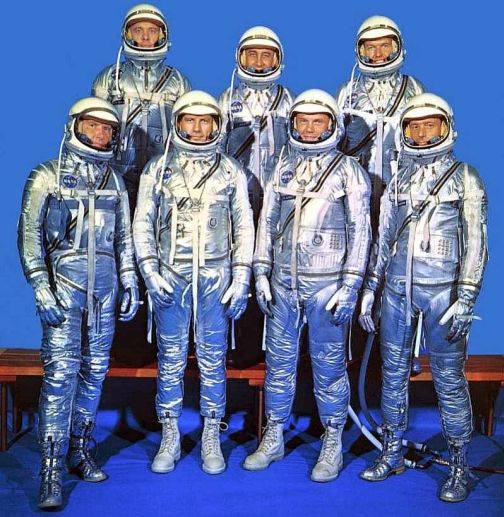
On this day in 1959, NASA announced The Mercury Seven: the seven men to make up their first astronaut class.

The Mercury Seven were chosen in Washington, DC from a body of 69 candidates. The name comes from Mercury, a Roman mythological god who is seen as a symbol of speed. Because of the small space inside the Mercury capsule, candidates could be no taller than 5 feet 11 inches and weigh no more than 180 pounds. The initial flights took off throughout the early 1960s, though some astronauts were active in later decades. Here are the guys:

Malcolm Scott Carpenter (born 1925) was a US Navy piolot aviation cadet who flew missions during the Korean War. He was on board the MA-7 (Aurora 7) and was the first American astronaut to eat solid food in space. He successfully overcame an overexpenditure of fuel due to hardware problems on his one and only mission. Carpenter was forced to retire from spaceflight after sustaining a motorbike accident. After retiring from the Navy, he founded Sea Sciences Inc., a corporation for developing programs for utilizing ocean resources and improving environmental health.

Leroy Gordon (Gordo) Cooper Jr. (1927 – 2004) was very active in the Boy Scouts of America and achieved the second highest rank of Life Scout. Prior to joining NASA, Cooper also served in the US Air Force and Marine Corps. He was on board the MA-9 (Faith 7) and Gemini 5, and developed a personal survival knife for astronauts to carry. Cooper was the first American to sleep in orbit. Interestingly, he took photos of and reported UFO sightings to the Pentagon, but they swept the incident under the rug.

John Herschel Glenn Jr. (born 1921) began his career as a US Marine Corps fighter pilot. He was on board the MA-6 (Friendship 7) and STS-95. Noticed for his heroics in space, Glenn became friendly with the Kennedys and a prominent public figure. After retiring from NASA, he ran as a Democrat and represented the state of Ohio in the United States Senate from 1974 to 1999.

Virgil Ivan (Gus) Grissom (1926 – 1967) was a US Air Force pilot before joining NASA. He was on board the MR-4 (Liberty Bell 7), Gemini 3, and Apollo 1. Grissom was tragically killed along with fellow astronauts Ed White and Roger Chaffee during a pre-launch test for the Apollo 1 mission. After death, his family was involved in a spacesuit controversy: NASA insisted Grissom got authorization to use his spacesuit for a show and tell at his son’s school and never returned it, but his family claimed the he had rescued the spacesuit from a scrap heap and that it rightfully belonged to them.

Walter Marty (Wally) Schirra Jr. (1923 – 2007)’s father was a pilot, and his mother performed wing walking stunts when he was on duty. Schirra served as an officer in the US Navy, and was later dispatched to South Korea as a pilot on loan to the US Air Force. On board the MA-8 (Sigma 7), Gemini 6A, and Apollo 7, he was the only person to fly in all of America’s first three space programs. Schirra gained notoriety for playing “Jingle Bells” on a harmonica he smuggled on board Gemini.

Alan Bartlett Shepard Jr. (1923 – 1998) began as a US Navy as test pilot. He was the first American in space, and flew on board the MR-3 (Freedom 7) and Apollo 14. It’s said that shortly before one launch, Shepard blurted out “Please, dear God, don’t let me fuck up.” This has since become known among aviators as “Shepard’s Prayer.” A successful businessman, Shepard was the first astronaut to become a millionaire while still in the program. His hometown of Derry, NH almost changed its name to “Spacetown” in honor of Schirra’s career.

Donald Kent (Deke) Slayton (1924 – 1993) was also a US Air Force pilot before joining NASA. He was grounded from space flight by a heart condition, but served as NASA’s Director of Flight Crew Operations. Slayton served as head of Astronaut selection. In 1972 he was granted medical clearance to fly as docking module pilot of the Apollo-Soyuz Test Project. At the time of the flight, he became the oldest person to fly into space.

The last surviving members of the Mercury Seven, as of April 7, 2012, are Glenn and Scott Carpenter.

Paul Harvey… Good Day (and goodbye)

Paul Harvey

Paul Harvey Aurandt (September 4, 1918 – February 28, 2009)

Paul Harvey was an American radio broadcaster for the ABC Radio Networks. He broadcast News and Comment on weekday mornings and mid-days, and at noon on Saturdays, as well as his famous The Rest of the Story segments. His listening audience was estimated at 22 million people a week.

Harvey was known for catch phrases that he uses at the beginning of his programs, like “Hello Americans, I’m Paul Harvey. You know what the news is, in a minute, you’re going to hear … the rest of the story,” and, “Paul Harvey News and Commentary, and this is … (day of the week),” and at the end: “Paul Harvey … Good day.” At the end of a report about someone who had done something ridiculous or offensive, Harvey would say “He would want us to mention his name” (silence) then would start the next item.

Wikipedia Link

In Remembrance – Space Shuttle Columbia & Crew

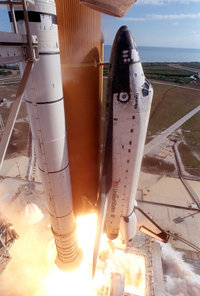
On February 1, 2003, the Space Shuttle Columbia disintegrated during re-entry on its 28th mission; all seven crew members aboard perished.

Columbia Launch STS-107

Columbia launches on its final mission, STS-107.

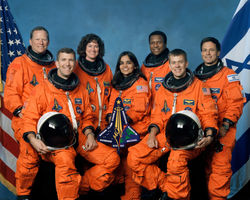
Columbia STS-107 Crew

The crew of STS-107. L to R: Brown, Husband, Clark, Chawla, Anderson, McCool, Ramon.

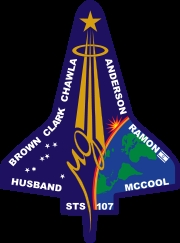
Columbia STS-107 Mission Patch

Columbia STS-107 Mission Patch.

Wikipedia Link

In Remembrance – Space Shuttle Challenger & Crew

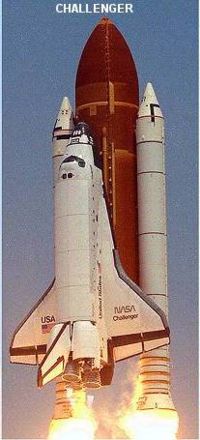
On January 28, 1986, the Space Shuttle Challenger disintegrated 73 seconds into its flight after an O-ring seal in its right solid rocket booster (SRB) failed at liftoff.

Challenger STS-51 at Launch

Challenger launches on its final mission, STS-51.

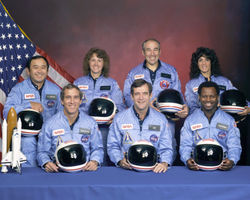
Challenger STS-51 Crew

The crew of STS-51. Front row, from left to right: Smith, Scobee, and McNair. Back row, from left to right: Onizuka, McAuliffe, Jarvis, and Resnik.

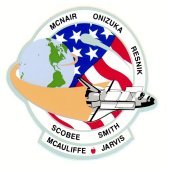
Challenger STS-51 Mission Patch

STS-51 mission patch.

Wikipedia Link

Pearl Harbor

Flag at half mast

My personal thanks for all of those who served, lived and died.

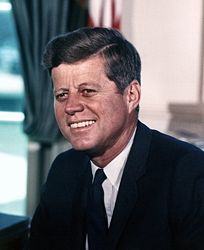
John F. Kennedy

John F. Kennedy

John Fitzgerald Kennedy (May 29, 1917–November 22, 1963)

The assassination of John F. Kennedy, the thirty-fifth President of the United States, took place on Friday, November 22, 1963, in Dallas, Texas, USA at 12:30 p.m. CST (18:30 UTC). John F. Kennedy was fatally wounded by gunshots while riding with his wife Jacqueline in a presidential motorcade through Dealey Plaza. Kennedy was assassinated by Lee Harvey Oswald, an employee of the Texas School Book Depository in Dealey Plaza, according to the conclusions of multiple government investigations, including the ten-month investigation of the Warren Commission of 1963-4 and the United States House Select Committee on Assassinations (HSCA) of 1976-9. This conclusion initially met with widespread support among the American public, but polls, since the original 1966 Gallup poll, show a majority of the public hold beliefs contrary to these findings. The assassination is still the subject of widespread speculation and has spawned numerous conspiracy theories (even the HSCA, based on disputed acoustical evidence, concluded that Oswald may have had unspecified co-conspirators), though these theories have not generally been accepted by mainstream historians and no single compelling alternative theory has emerged.

Happy Birthday, ISS

On November 20, 1998, the first segment of the ISS, the Zarya FGB, was launched into orbit on a Russian Proton rocket, and was followed two weeks later by the first of three ‘node’ modules, Unity, launched aboard STS-88.

Wikipedia Link

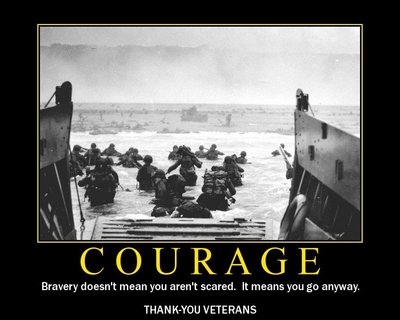
Veteran’s Day

Veteran's Day

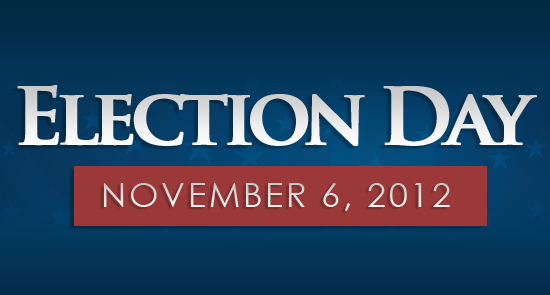
Election Day

Election Day 2012

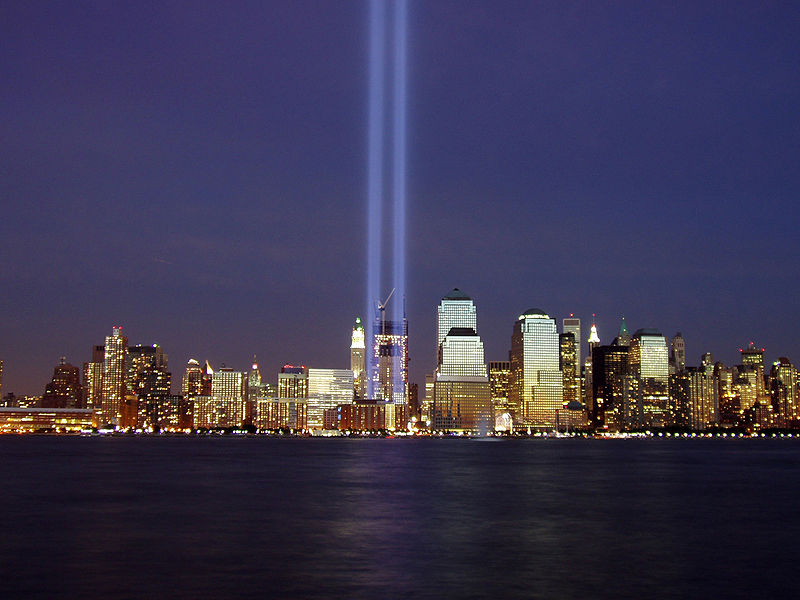
September 11

Tribute in LightClick for larger image

September 11, 2001

Please observe a moment of silence at 8:46 a.m. (1246 GMT) to mark the moment when the first plane hit one tower and at 9:03 a.m. (1303 GMT), when the second hijacked airliner crashed into the other tower, and again at 9:59 a.m. (1359 GMT) and 10:29 a.m. (1429 GMT) when each tower crumbled.

United States nicknamed ‘Uncle Sam’

On September 7, 1813, the United States gets its nickname, Uncle Sam. The name is linked to Samuel Wilson, a meat packer from Troy, New York, who supplied barrels of beef to the United States Army during the War of 1812. Wilson (1766-1854) stamped the barrels with “U.S.” for United States, but soldiers began referring to the grub as “Uncle Sam’s.” The local newspaper picked up on the story and Uncle Sam eventually gained widespread acceptance as the nickname for the U.S. federal government.

In the late 1860s and 1870s, political cartoonist Thomas Nast (1840-1902) began popularizing the image of Uncle Sam. Nast continued to evolve the image, eventually giving Sam the white beard and stars-and-stripes suit that are associated with the character today. The German-born Nast was also credited with creating the modern image of Santa Claus as well as coming up with the donkey as a symbol for the Democratic Party and the elephant as a symbol for the Republicans. Nast also famously lampooned the corruption of New York City’s Tammany Hall in his editorial cartoons and was, in part, responsible for the downfall of Tammany leader William Tweed.

Perhaps the most famous image of Uncle Sam was created by artist James Montgomery Flagg (1877-1960). In Flagg’s version, Uncle Sam wears a tall top hat and blue jacket and is pointing straight ahead at the viewer. During World War I, this portrait of Sam with the words “I Want You For The U.S. Army” was used as a recruiting poster. The image, which became immensely popular, was first used on the cover of Leslie’s Weekly in July 1916 with the title “What Are You Doing for Preparedness?” The poster was widely distributed and has subsequently been re-used numerous times with different captions.

In September 1961, the U.S. Congress recognized Samuel Wilson as “the progenitor of America’s national symbol of Uncle Sam.” Wilson died at age 88 in 1854, and was buried next to his wife Betsey Mann in the Oakwood Cemetery in Troy, New York, the town that calls itself “The Home of Uncle Sam.”

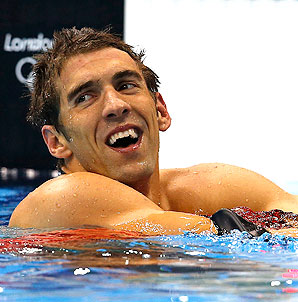
Michael Phelps Wins 19th Gold Medal: Greatest Olympian Ever!

Yes, it’s official now—Phelps has a record 19 Olympic medals, and he’s NOT DONE YET!

Michael Phelps

Michael Phelps has done it. He is now the all-time leading overall medalist in Olympics history.

In the 200-meter butterfly, he took silver to tie the record of 18 medals set by Soviet Union gymnast Larisa Latynina. Then, Phelps made history—as he always does—as the United States won gold in the 4×200-meter freestyle relay.

The number 19 is a magical number in the world of sports. Phelps needed 19 medals to become the greatest Olympian of all time; a perfect season in the NFL is 19-0, including the playoffs, and 19 major golf championships would surpass Jack Nicklaus’s leading total of 18. But no NFL team has gone 19-0, and Nicklaus still remains No. 1 in golf.

Michael Phelps is the real thing. After so many years of anticipation, he is the most decorated Olympian in the history of the Games. Now, let us recount the highlights of his journey to the pinnacle.

“The Eagle has landed.” Remembering Apollo 11: July 20, 1969


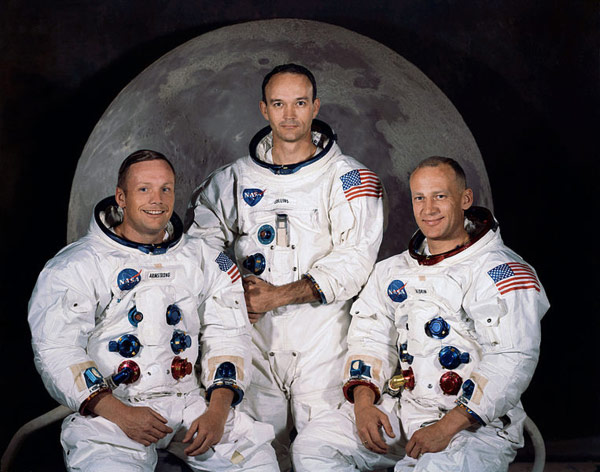
Apollo 11

Left to right: Neil Armstrong, Michael Collins, and Buzz Aldrin, the crew of Apollo 11. Photo: NASA.

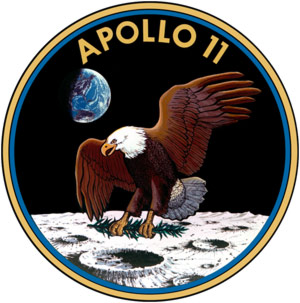
Apollo 11 Insignia 

On this day in 1969, humans walked on the moon for the first time. The Apollo 11 spaceflight brought Americans Neil Armstrong and Buzz Aldrin to the lunar surface on July 20, 1969, at 20:18 UTC.

Michael Collins, the mission’s third member, remained in lunar orbit. All three men returned safely to Earth after an 8-day mission that began with a Saturn V rocket launch from Kennedy Space Center in Merritt Island, Florida on July 16.

This was the fifth manned mission of NASA’s Apollo program, which ran from 1963 to 1972 and included 6 missions that landed on the moon. These were the first and last times human beings set foot on another world.

NASA has a collection of restored HD videos well worth watching on this historic day.

All 135 Space Shuttle Launches… at once…


Happy 4th of July!

4th of July

Congress adopts the Stars and Stripes

During the American Revolution, the Continental Congress adopts a resolution stating that “the flag of the United States be thirteen alternate stripes red and white” and that “the Union be thirteen stars, white in a blue field, representing a new Constellation.” The national flag, which became known as the “Stars and Stripes,” was based on the “Grand Union” flag, a banner carried by the Continental Army in 1776 that also consisted of 13 red and white stripes. According to legend, Philadelphia seamstress Betsy Ross designed the new canton for the Stars and Stripes, which consisted of a circle of 13 stars and a blue background, at the request of General George Washington. Historians have been unable to conclusively prove or disprove this legend.

With the entrance of new states into the United States after independence, new stripes and stars were added to represent new additions to the Union. In 1818, however, Congress enacted a law stipulating that the 13 original stripes be restored and that only stars be added to represent new states.

On June 14, 1877, the first Flag Day observance was held on the 100th anniversary of the adoption of the Stars and Stripes. As instructed by Congress, the U.S. flag was flown from all public buildings across the country. In the years after the first Flag Day, several states continued to observe the anniversary, and in 1949 Congress officially designated June 14 as Flag Day, a national day of observance.

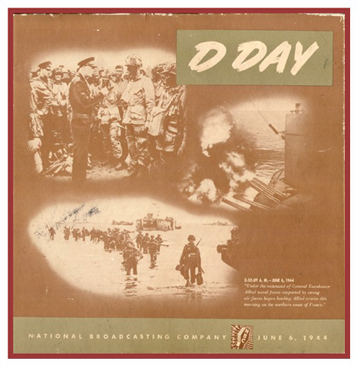
D-Day

D DayJune 6, 1944
Flag at Half Mast

Veteran

A veteran is someone who, at one point in his life, wrote a blank check made payable to his country for an amount of ‘up to and including my life.’