



















- Beef on Weck
- Being a Mother
- Chili Cook-off
- Communication (Gazebo)
- CREAMI Vanilla Ice Cream
- Daddy
- Everyone has an Angel
- Family
- Gonna be a Bear
- Harrison Bergeron
- Mute and Alone
- Privacy Policy
- Rikki-tikki-tavi
- Scientists Study Grizzly Bears
- Ship vs. Lighthouse
- Slim To None
- Snowvember (Buffalo 2014)
- Somebody…
- The Present
- The Soldier
- The Star
- Winter
- 11foot8.com
- 365 Tomorrows
- 7 into 28
- A Tale of Two Brains
- Alien to Covenant – History of Alien
- Am I Unique
- AMARC
- American Muscle Car Museum
- Andre Rieu
- Antipodes Map
- Ark in Space
- Azure Status
- Bill Cosby – Revenge
- Blizzard of '77
- Broken Chains
- CDC – Flu
- Christmas Forever AZ
- Coldest City on Earth
- Creations for Charity (Lego)
- Cruise.com
- Curb Watching
- D&D Beyond
- D&D Beyond to FG Character Converter
- Daily Fuel Gauge Report
- Dinosaur Earth
- DMs Guild
- Dofo
- Dr. Demento
- DriveThru RPG
- Dungeon in a Box
- Dyson’s Dodecahedron
- Fantasy Name Generator
- Farmer's Donkey
- Fast Character
- Flight Aware
- Flight Radar 24
- Flixable
- Gaming Table
- Genius
- Geo Guesser!
- Hack The Menu
- Hackers for Charity
- Hadzy
- Have I been Pwned
- HexRoll
- How to remove a tick (properly)
- Identity Theft Resource Center
- Leak Lookup
- Line Rider – Hall of the Mountain King
- Make My Drive Fun
- Mapologies
- Marine Traffic
- MathPapa
- MechWarrior Online
- Medieval Murder Maps
- Meteor Shower Calendar
- Mini Building Materials
- Monterey Bay Aquarium
- MyAbandonware
- Nah! I just might be in there!
- National Do Not Call Registry
- No More Ransom
- NOAA – Louisville
- Nobody Live
- Norse Cyber Attack Map
- OCEARCH.org
- Omega Game Shrine
- Out of the Woods Forestry
- Overt
- PC Gaming Wiki
- Percheron
- Periodic Stats
- Periodic Videos (TED)
- Permethin Fact Sheet
- Pigeon Key Foundation
- Project 44
- pTable
- Pumpkin Pile
- Random Restaurant Generator
- Rankin/Bass – Wikipedia
- ReelGood
- RockAuto
- Roll20 Enhancement Suite
- Schimpff's
- Scuba Shooters
- Sinking of the Titanic
- Smoky Mountain Fall Foliage Map
- Speedsums
- SR-71 Speed Check
- Steam Status
- Still Tasty
- StreamSquid
- Sunken Ships of the Second World War
- Super Slice!
- Swedish Fish
- Tank America
- Taste Dive
- TBSP (TaBleSPoon)
- The Louvre
- The Oz Museum
- The Strong National Museum of Play
- They Can Talk
- This Beat Goes on/Switchin' to Glide
- Tick Removal (CDC)
- Trappistine Candy
- Vacation Rentals By Owner
- Vehicle Privacy Report
- VPNFilter Check
- War Puppets Rise to Heaven
- Weather Back Home
- WebGL Water
- Whalers on the Moon
- What's New on Netflix
- Who's On First
- Why are Jacks called Jacks?
- Wild Spirit
- Window Swap
- WKRP Turkey Drop
- Wordcount
- World's Hottest Chocolate Bar
- WWII Portraits of Honor
- March 2026
- February 2026
- January 2026
- December 2025
- November 2025
- October 2025
- September 2025
- August 2025
- July 2025
- June 2025
- May 2025
- April 2025
- March 2025
- February 2025
- January 2025
- December 2024
- November 2024
- October 2024
- September 2024
- August 2024
- July 2024
- June 2024
- May 2024
- April 2024
- March 2024
- February 2024
- January 2024
- December 2023
- November 2023
- October 2023
- September 2023
- August 2023
- July 2023
- June 2023
- May 2023
- April 2023
- March 2023
- February 2023
- January 2023
- December 2022
- November 2022
- October 2022
- September 2022
- August 2022
- July 2022
- June 2022
- May 2022
- April 2022
- March 2022
- February 2022
- January 2022
- December 2021
- November 2021
- October 2021
- September 2021
- August 2021
- July 2021
- June 2021
- May 2021
- April 2021
- March 2021
- February 2021
- January 2021
- December 2020
- November 2020
- October 2020
- September 2020
- August 2020
- July 2020
- June 2020
- May 2020
- April 2020
- March 2020
- February 2020
- January 2020
- December 2019
- November 2019
- October 2019
- September 2019
- August 2019
- July 2019
- June 2019
- May 2019
- April 2019
- March 2019
- February 2019
- January 2019
- December 2018
- November 2018
- October 2018
- September 2018
- August 2018
- July 2018
- June 2018
- May 2018
- April 2018
- March 2018
- February 2018
- January 2018
- December 2017
- November 2017
- October 2017
- September 2017
- August 2017
- July 2017
- June 2017
- May 2017
- April 2017
- March 2017
- February 2017
- January 2017
- December 2016
- November 2016
- October 2016
- September 2016
- August 2016
- July 2016
- June 2016
- May 2016
- April 2016
- March 2016
- February 2016
- January 2016
- December 2015
- November 2015
- October 2015
- September 2015
- August 2015
- July 2015
- June 2015
- May 2015
- April 2015
- March 2015
- February 2015
- January 2015
- December 2014
- November 2014
- October 2014
- September 2014
- August 2014
- July 2014
- June 2014
- May 2014
- April 2014
- March 2014
- February 2014
- January 2014
- December 2013
- November 2013
- October 2013
- September 2013
- August 2013
- July 2013
- June 2013
- May 2013
- April 2013
- March 2013
- February 2013
- January 2013
- December 2012
- November 2012
- October 2012
- September 2012
- August 2012
- July 2012
- June 2012
- May 2012
- April 2012
- March 2012
- February 2012
- January 2012
- December 2011
- November 2011
- October 2011
- September 2011
- August 2011
- July 2011
- June 2011
- May 2011
- April 2011
Category Archives: Planes Trains and Automobiles
In Remembrance – Space Shuttle Columbia & Crew
On February 1, 2003, the Space Shuttle Columbia disintegrated during re-entry on its 28th mission; all seven crew members aboard perished.
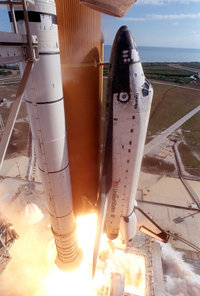
Columbia launches on its final mission, STS-107.

The crew of STS-107. L to R: Brown, Husband, Clark, Chawla, Anderson, McCool, Ramon.
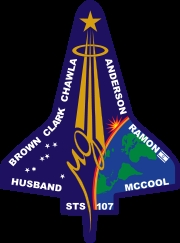
Columbia STS-107 Mission Patch.
Posted in Because I Can, On This Day, Patriotic, Planes Trains and Automobiles
In Remembrance – Space Shuttle Challenger & Crew
On January 28, 1986 at 11:39 EST, the Space Shuttle Challenger disintegrated 73 seconds into its flight after an O-ring seal in its right solid rocket booster (SRB) failed at liftoff. All seven astronauts on board were lost.
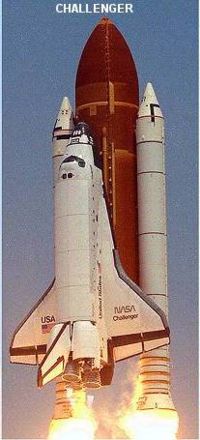
Challenger launches on its final mission, STS-51.
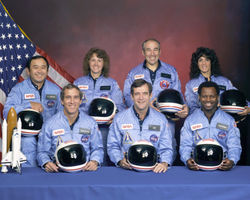
The crew of STS-51. Front row, from left to right: Smith, Scobee, and McNair. Back row, from left to right: Onizuka, McAuliffe, Jarvis, and Resnik.
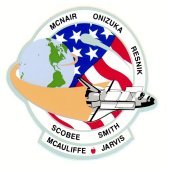
STS-51 mission patch.
Posted in Because I Can, On This Day, Patriotic, Planes Trains and Automobiles
For Real ‘mech

Behold the 13-foot tall 1.5-ton “Method-2,” brainchild of South Korean robotics company Hankook Mirae Technology, which is taking its first “baby steps” under the watchful eyes of about 30 engineers and members of the media this week.
https://youtu.be/ygPfWClMvk4
Article at Jalopnik: here
Posted in Because I Can, Planes Trains and Automobiles
Top Gear’s Famous Test Track Is About To Turn Into A Housing Development
In a narrow vote on Wednesday, the BBC reports that a local council in Surrey, England approved plans to redevelop Dunsfold Aerodrome and build 1,800 new homes. That name may sound familiar, because Dunsfold Aerodrome is the site of the test track used by Top Gear.
Guess the BBC doesn’t think much of the new Top Gear either… 🙂
Posted in Because I Can, Planes Trains and Automobiles
Driver Flips In Brutal High-Speed Crash And Wins Race After Sliding On His Roof
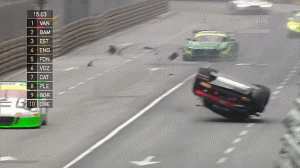
FIA GT World Cup Audi R8 LMS racer Laurens Vanthoor clipped the inside curb at Macau’s Mandarin Bend at 155 mph, sending him out of control into the wall on the other side of the track, per Motorsport.com. Vanthoor’s Audi flipped over and started sliding on its roof, immediately triggering a red flag to stop the race.
In case you’re not familiar with the Macau Grand Prix, it’s a race weekend held on a thoroughly insane, super-narrow street course. A pile-up at the wrong spot can clog the full width of the track and completely stop a race, but that doesn’t prevent drivers from going balls-out and bouncing off every corner of the tight walls.
In case you’re not familiar with the Macau Grand Prix, it’s a race weekend held on a thoroughly insane, super-narrow street course. A pile-up at the wrong spot can clog the full width of the track and completely stop a race, but that doesn’t prevent drivers from going balls-out and bouncing off every corner of the tight walls.
In other words, this crash may be the most Macau thing to happen ever.
Vanthoor described the experience as surreal to Motorsport.com, and confirmed that he was fine:
Physically I am okay. It is fine. It is just one of the nastiest corners to do a crash.To do half the straight upside down and see the other cars coming is something not really describable. It was a scary memory in my mind. But besides that physically I am okay.
Vanthoor was able to climb out of his Orlove’d car safely, under his own power.
The race was not restarted, as had already been delayed due to a prior crash, according to Motorsport.com. While Vanthoor had just been passed by Earl Bamber’s Porsche 911 before the crash, they opted to declare the winner based on the results of the previous lap, where Vanthoor was ahead.
Because of this, Vanthoor told Motorsport.com that he had mixed feelings about taking the win:
I don’t really know if I deserved it in a way, as I crashed and made a mistake and I am still a winner – which is very awkward. But I don’t really know what to say. It would have been a better show for everybody without the crash and a better victory, but I don’t know what to think about it.
Porsche, of course, was obviously not happy about the race result, as their driver Earl Bamber had passed Vanthoor before the red flag. Porsche wrote in their post-race press release:
When the race for the FIA GT World Cup in Macau was stopped and not restarted, the New Zealander Earl Bamber was in the lead at the wheel of the Porsche 911 GT3 R. However, the stewards of the meeting awarded the prestigious win on the legendary city circuit in the former Portuguese colony to Belgium’s Laurens Vanthoor – the very driver who had just been overtaken by the Porsche in a sensational manoeuvre, and had caused the race to be called off after his serious accident.
Salty! But understandable.
Bamber had been assessed a five-second penalty for squeezing another car into the wall at the start, which caused him to be classified fourth, reports Motorsport.com. Fellow Porsche racer Kévin Estre, who was right behind Vanthoor before the crash, was classified in second place.
Posted in Humor, Planes Trains and Automobiles
The Plane That Flew Itself
In 1970, a plane got fed up with its pilot so it hatched an audacious plan. First, get rid of the pilot. Second: land. Third: enter history. The result was amazing.
On February 2, 1970 four pilots of the 71st Fighter-Interceptor Squadron were to take off from the Malmstrom Air Force Base in Montana. They were to do so on Convair F-106A-100-CO Delta Darts and engage in mock combat.
But one plane had ideas of its own. Just as it was about to take off, its drag chute deployed – forcing its pilot to abort.
So then there were three. Major Tom Curtis was to “fight” Major Jim Lowe and Captain Gary Faust. No problem – they’d been through this before. Or so they thought.
The three split up to begin their dogfight. Once they were 20 miles apart, ground controllers gave them all different vectors to ensure that each had a fair chance. From that point on, they could do whatever they felt was necessary to win.
Curtis went after Faust first, so he accelerated to Mach 1.90. The plan was to force Faust into a vertical engagement that would put him at a disadvantage.
The three planes zoomed toward each other and overshot. Curtis climbed, forcing the other two to try and catch up. Having entered the climb faster, he had the advantage, but it couldn’t last.
So he switched to vertical scissors – using his speed to climb and dive in a spiral while doing a barrel roll. He then took it a step further by widening his spirals, forcing the other two to break out of their own climb.
Once past 38,000 feet, Curtis did a high-G rudder reversal – turning and rolling to reduce his thrust, thereby forcing his “enemy” to overshoot him. It worked… sort of. Faust took the bait, which probably annoyed his plane.
Tail number 58-0787 shuddered, then went into an accelerated stall – meaning it suddenly plunked its nose downward. Then it made a beeline toward the ground.
Curtis saw it all. From his angle, it looked as if the plane’s tail was doing a slow circuit around its wobbling nose – disaster! It’s called a flat spin. And once an F-106A does that, it’s almost as good as dead.
Fortunately, the men were seasoned, professional pilots. Lowe’s calm voice came over Faust’s radio – carefully going over spin recovery procedures step-by-step. Faust followed them all faithfully, trying to maneuver the plane’s nose at an angle that would break its spin.
He set the plane’s trim to the take-off position, but 58-0787 refused to respond. Trimming frees the pilot from having to exert constant pressure on the controls, but it did no good. Nothing worked.
There was only one thing left to do – activate the drag chute. This wasn’t meant to be used in flight, however. It’s only for extra braking when a plane lands. The hope was that it would slow the plane down enough so Faust could get it at the angle needed to break its spin.
So he deployed it, and off it went… wrapping itself around 58-0787’s vertical stabilizer. Perhaps even more annoyed by that, the F-106A continued its downward spiral of doom. Faust had exhausted all of his options.
And having fallen below the 15,000 feet mark, he had also run out of time. If he was to survive, he had to bail – so he did.
It was the signal that 58-0787 was waiting for. The blast that catapulted Faust out was exactly what was needed to push its nose straight down.
The plane broke out of its spin, leveled off, and resumed flying in a straight line – albeit with a slight left and right wobbling. Even better, Faust had set the trim to take-off, which was similar to the landing trim position. And best of all, he had moved the throttle to “idle” – putting the plane into a steady gliding descent.
Except that he was no longer in it. Lowe saw it all and couldn’t help laughing, “Gary? You better get back into that thing!”
But 58-0787 was having none of it. Freed of its human, at last, it flew off into the vast blue skies above northern Montana. Faust, meanwhile, could only watch in awe as his plane continued to fly on without him as he slowly parachuted down into the snow-covered Bear Paw Mountains.
Curtis and Lowe radioed his position and headed back to base. All three hoped that wherever 58-0787 crashed, it wouldn’t be on anyone below. As for Faust, he was rescued shortly after landing by a group of Native Americans on snowmobiles.
But 58-0787 had no intention of crashing. Traveling at about 175 knots, it reveled in its new-found freedom till it reached the town of Big Sandy (population: 598 in 2010) in Chouteau County. Seeing a lovely snow-covered alfalfa field, it made a slow, steady downward glide till it touched ground.
Delighted by the snow, it continued to slide, making sure to stay steady and avoid letting either wing touch the earth. But there was trouble ahead. Cutting across the field at an angle to its approach lay a low, stone wall with only a narrow gap in the middle.
So 58-0787 slid to the right, did a 20° turn, slipped through the opening, and continued on into the next field where it finally stopped before an astonished farmer. The man called the sheriff, of course, who called the base.
They asked him to assess the damage, but each time he tried to get close, 58-0787 would jiggle and dance, trying to get away. Finally, the authorities told him to just let the thing be – it would run out of fuel, eventually.
By the time the military got there, it had done just that – almost two hours later. So they took off its wings and hauled it back to base. To their surprise, except for some superficial scratches on its underside, it was still flight-worthy and later put back in active service.
They called Faust the “Cornfield Bomber” after that, but he was not a bomber. Nor did 58-0787 land in a cornfield. It now rests at the National Museum of the US Air Force, restored to its former glory, and no doubt reminiscing about its Montana adventure.
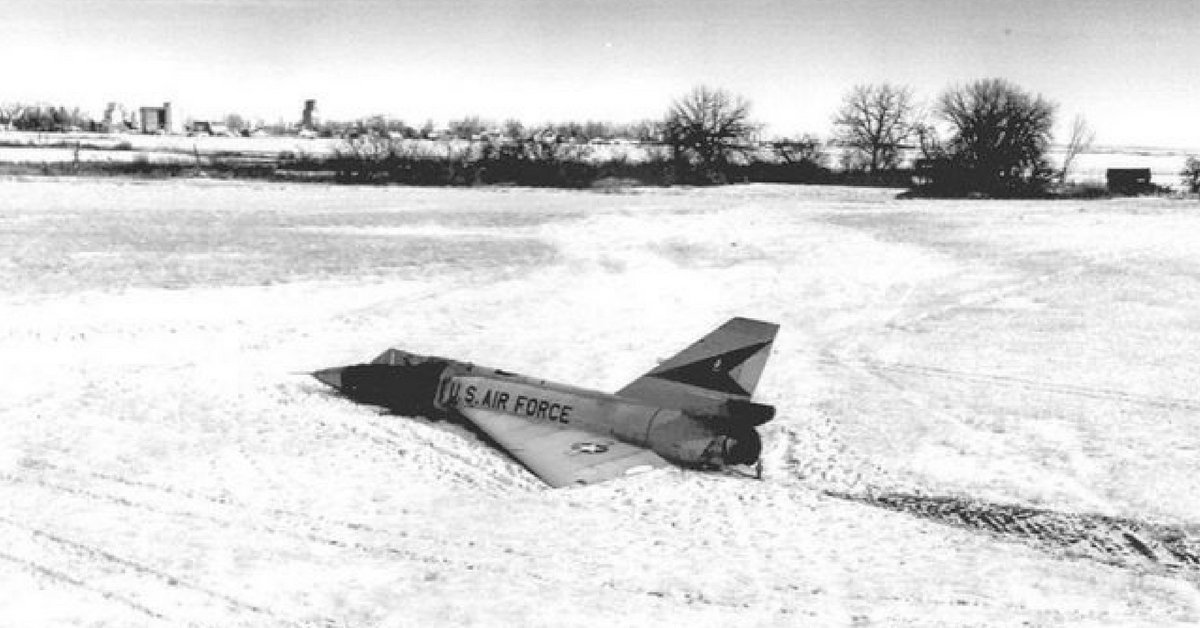
58-0787 resting on an alfalfa field in Montana
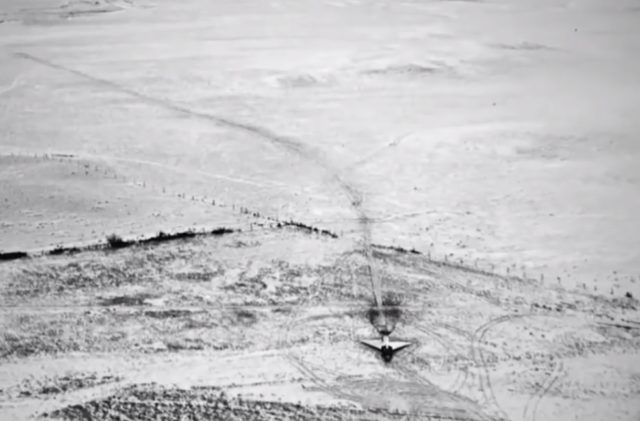
58-0787 after making a right turn to avoid the stone wall

Major Gary Foust (retired) with 58-0787 (also retired) behind him
Posted in Because I Can, Humor, Planes Trains and Automobiles
Anniversary of the sinking of the USS Johnston
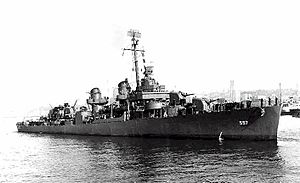
USS Johnston (DD-557) was a World War II-era Fletcher-class destroyer in the service of the United States Navy. She was the first Navy ship named after Lieutenant John V. Johnston. The ship was most famous for its bold action in the Battle off Samar. The small “tincan” destroyer armed with nothing larger than 5 inch (127mm) guns and torpedoes would lead the attack of a handful of light ships which had inadvertently been left unprotected in the path of a massive Japanese fleet led by battleships and cruisers. The sacrifices of Johnston and her little escort carrier task unit “Taffy 3” helped stop Admiral Kurita’s powerful Center Force from attacking vulnerable U.S. landing forces, and inflicted greater losses than they suffered.
Posted in Because I Can, On This Day, Patriotic, Planes Trains and Automobiles
Yeager Breaks Sound Barrier
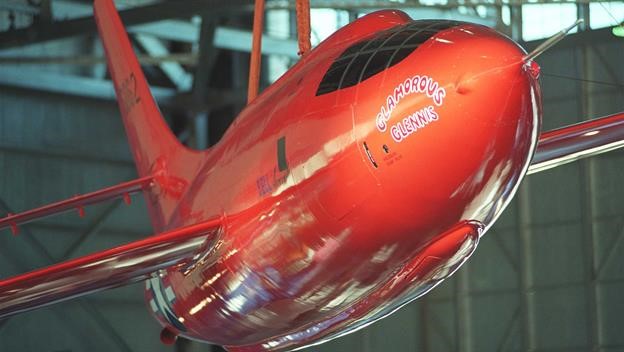
U.S. Air Force Captain Chuck Yeager becomes the first person to fly faster than the speed of sound.
Yeager, born in Myra, West Virginia, in 1923, was a combat fighter during World War II and flew 64 missions over Europe. He shot down 13 German planes and was himself shot down over France, but he escaped capture with the assistance of the French Underground. After the war, he was among several volunteers chosen to test-fly the experimental X-1 rocket plane, built by the Bell Aircraft Company to explore the possibility of supersonic flight.
For years, many aviators believed that man was not meant to fly faster than the speed of sound, theorizing that transonic drag rise would tear any aircraft apart. All that changed on October 14, 1947, when Yeager flew the X-1 over Rogers Dry Lake in Southern California. The X-1 was lifted to an altitude of 25,000 feet by a B-29 aircraft and then released through the bomb bay, rocketing to 40,000 feet and exceeding 662 miles per hour (the sound barrier at that altitude). The rocket plane, nicknamed “Glamorous Glennis,” was designed with thin, unswept wings and a streamlined fuselage modeled after a .50-caliber bullet.
Because of the secrecy of the project, Bell and Yeager’s achievement was not announced until June 1948. Yeager continued to serve as a test pilot, and in 1953 he flew 1,650 miles per hour in an X-1A rocket plane. He retired from the U.S. Air Force in 1975 with the rank of brigadier general.
Posted in On This Day, Planes Trains and Automobiles
SR-71 ‘Blackbird’ Sets ‘Speed Over a Recognized Course’ record
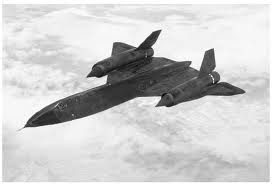
The SR-71 holds the “Speed Over a Recognized Course” record for flying from New York to London distance 3,508 miles (5,646 km), 1,435.587 miles per hour (2,310.353 km/h), and an elapsed time of 1 hour 54 minutes and 56.4 seconds, set on September 1, 1974 while flown by U.S. Air Force Pilot Maj. James V. Sullivan and Maj. Noel F. Widdifield, reconnaissance systems officer (RSO). This equates to an average velocity of about Mach 2.68, including deceleration for in-flight refueling. Peak speeds during this flight were probably closer to the declassified top speed of Mach 3.2+. For comparison, the best commercial Concorde flight time was 2 hours 52 minutes, and the Boeing 747 averages 6 hours 15 minutes.
Posted in Because I Can, Planes Trains and Automobiles
