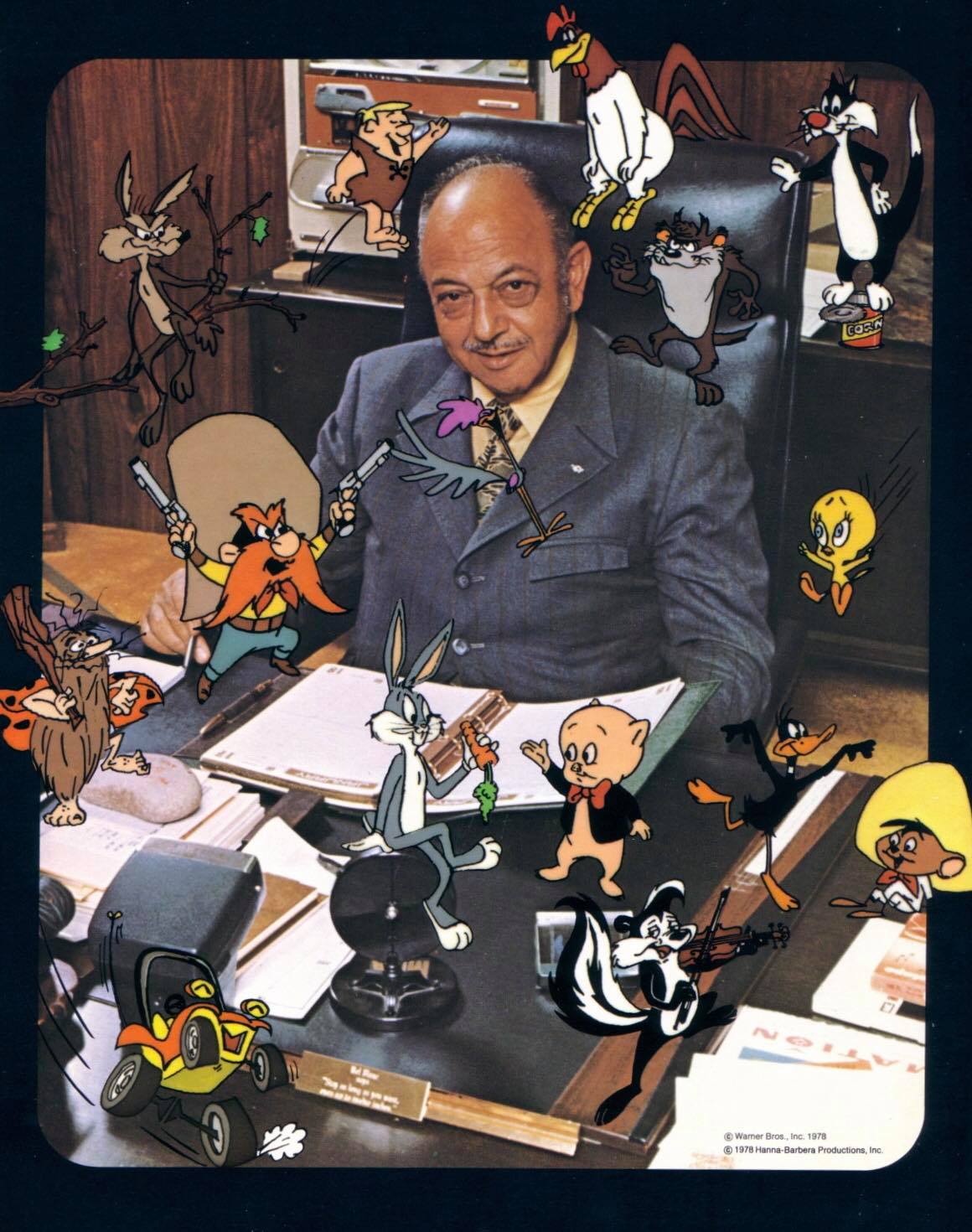
Happy Birthday to the Man of 1000 voices

Mel Blanc (May 30, 1908 – July 10, 1989).

Mel Blanc (born Melvin Jerome Blank, May 30, 1908 – July 10, 1989) was an American voice actor and radio personality. After beginning his over-60-year career performing in radio, he became known for his work in animation as the voices of Bugs Bunny, Daffy Duck, Porky Pig, and most of the other characters from the Looney Tunes and Merrie Melodies theatrical cartoons during the golden age of American animation.

He later voiced characters for Hanna-Barbera’s television cartoons, including Barney Rubble on The Flintstones and Mr. Spacely on The Jetsons. During the golden age of radio, Blanc also frequently performed on the programs of comedians, including Jack Benny, Abbott and Costello, Burns and Allen, The Great Gildersleeve, and Judy Canova.

Blanc was nicknamed “The Man of a Thousand Voices”, and is regarded as one of the most influential people in the voice acting industry.

Wikipedia Link

Memorial Day / Veteran’s Day

Memorial Day

Flag at Half Mast
Memorial Day

Memorial Day is a United States federal holiday observed on the last Monday of May. Formerly known as Decoration Day, it commemorates U.S. men and women who died while in the military service. First enacted to honor Union soldiers of the American Civil War (it is celebrated near the day of reunification after the civil war), it was expanded after World War I to include American casualties of any war or military action.

It Has Always Been The Soldier

Pallas Cat kittens playing with snow

Sinking of the Bismark

On May 27, 1941, the British navy sinks the German battleship Bismarck in the North Atlantic near France. The German death toll was more than 2,000.

On February 14, 1939, the 823-foot Bismarck was launched at Hamburg. Nazi leader Adolf Hitler hoped that the state-of-the-art battleship would herald the rebirth of the German surface battle fleet. However, after the outbreak of war, Britain closely guarded ocean routes from Germany to the Atlantic Ocean, and only U-boats moved freely through the war zone.

In May 1941, the order was given for the Bismarck to break out into the Atlantic. Once in the safety of the open ocean, the battleship would be almost impossible to track down, all the while wreaking havoc on Allied convoys to Britain. Learning of its movement, Britain sent almost the entire British Home Fleet in pursuit. On May 24, the British battle cruiser Hood and battleship Prince of Wales intercepted it near Iceland. In a ferocious battle, the Hood exploded and sank, and all but three of the 1,421 crewmen were killed. The Bismarck escaped, but because it was leaking fuel it fled for occupied France. On May 26, it was sighted and crippled by British aircraft, and on May 27 three British warships descended on the Bismarck and finished it off.

Happy Birthday, Bocephus!

Hank Williams, Jr. is an American country and southern rock artist, son of country music pioneer Hank Williams and father of Hank III and Holly Williams.

Known by the nickname Bocephus (a name given to him by his father because he thought his son as a baby resembled a TV ventriloquist dummy named Bocephus), he was raised by his mother Audrey after his father’s death in 1953. He was destined for fame, being taught how to play piano by Jerry Lee Lewis and guitar by Johnny Cash. He began performing when eight years old.

Hank Williams, Jr.
Hank Williams, Jr. (May 26, 1949 – )

Wikipedia Link

Towel Day

Towel Day

Today is Towel Day, a day of remembrance for Douglas Adams, author of the Hitchhikers’ Guide to the Galaxy. Observe it by carrying a towel all day.

Link

Anniversary of Alien!

Alien was released on May 25, 1979 in the United States and September 6 in the United Kingdom. It was met with critical acclaim and box office success, winning the Academy Award for Best Visual Effects, three Saturn Awards (Best Science Fiction Film, Best Direction for Scott, and Best Supporting Actress for Cartwright), and a Hugo Award for Best Dramatic Presentation, along with numerous other nominations. It has been consistently praised in the years since its release, and is considered one of the greatest films of all time. In 2002, Alien was deemed “culturally, historically or aesthetically significant” by the Library of Congress and was selected for preservation in the United States National Film Registry. In 2008, it was ranked by the American Film Institute as the seventh-best film in the science fiction genre, and as the thirty-third greatest film of all time by Empire magazine.

The success of Alien spawned a media franchise of films, novels, comic books, video games, and toys. It also launched Weaver’s acting career, providing her with her first lead role. The story of her character’s encounters with the Alien creatures became the thematic and narrative core of several sequels, prequels, and crossovers.

Wikipedia Link

Anniversary of Star Wars

Star Wars

May 25, 1977, Memorial Day weekend opens with an intergalactic bang as the first of George Lucas’ blockbuster Star Wars movies hits American theaters.

Wikipedia Link

How TETRIS was born

Ants and hornets

How they saved the holes in Swiss cheese

Scientists Found a Snake That Cartwheels Away From Danger

Deepish fish ever captured on film

Size comparison of primates

https://youtu.be/0BYgUaAhIF0

Size comparison of flying creatures

Size comparison of dogs

https://youtu.be/t2VtrFASCtY

Size comparison of felines

https://youtu.be/1U970STacm0

What actually doomed the Dodo

First Allied Jet Flies

On May 15, 1941, the jet-propelled Gloster-Whittle E 28/39 aircraft flies successfully over Cranwell, England, in the first test of an Allied aircraft using jet propulsion. The aircraft’s turbojet engine, which produced a powerful thrust of hot air, was devised by Frank Whittle, an English aviation engineer and pilot generally regarded as the father of the jet engine.

Whittle, born in Coventry in 1907, was the son of a mechanic. At the age of 16, he joined the Royal Air Force (RAF) as an aircraft apprentice at Cranwell and in 1926 passed a medical exam to become a pilot and joined the RAF College. He won a reputation as a daredevil flier and in 1928 wrote a senior thesis entitled Future Developments in Aircraft Design, which discussed the possibilities of rocket propulsion.

From the first Wright brothers flight in 1903 to the first jet flight in 1939, most airplanes were propeller driven. In 1910, the French inventor Henri Coanda built a jet-propelled bi-plane, but it crashed on its maiden flight and never flew again. Coanda’s aircraft attracted little notice, and engineers stuck with propeller technology; even though they realized early on that propellers would never overcome certain inherent limitations, especially in regard to speed.

After graduating from the RAF college, Whittle was posted to a fighter squadron, and in his spare time he worked out the essentials of the modern turbojet engine. A flying instructor, impressed with his propulsion ideas, introduced him to the Air Ministry and a private turbine engineering firm, but both ridiculed Whittle’s ideas as impractical. In 1930, he patented his jet engine concept and in 1936 formed the company Power Jets Ltd. to build and test his invention. In 1937, he tested his first jet engine on the ground. He still received only limited funding and support, and on August 27, 1939, the German Heinkel He 178, designed by Hans Joachim Pabst von Ohain, made the first jet flight in history. The German prototype jet was developed independently of Whittle’s efforts.

One week after the flight of the He 178, World War II broke out in Europe, and Whittle’s project got a further lease of life. The Air Ministry commissioned a new jet engine from Power Jets and asked the Gloster Aircraft Company to build an experimental aircraft to accommodate it, specified as E 28/39. On May 15, 1941, the jet-propelled Gloster-Whittle E 28/39 flew, beating out a jet prototype being developed by the same British turbine company that earlier balked at his ideas. In its initial tests, Whittle’s aircraft–flown by the test pilot Gerry Sayer–achieved a top speed of 370 mph at 25,000 feet, faster than the Spitfire or any other conventional propeller-driven machine.

As the Gloster Aircraft Company worked on an operational turbojet aircraft for combat, Whittle aided the Americans in their successful development of a jet prototype. With Whittle’s blessing, the British government took over Power Jets Ltd. in 1944. By this time, Britain’s Gloster Meteor jet aircraft were in service with the RAF, going up against Germany’s jet-powered Messerschmitt Me 262s in the skies over Europe.

Whittle retired from the RAF in 1948 with the rank of air commodore. That year, he was awarded 100,000 pounds by the Royal Commission on Awards to Inventors and was knighted. His book Jet: The Story of a Pioneer was published in 1953. In 1977, he became a research professor at the United States Naval Academy in Annapolis, Maryland. He died in Columbia, Maryland, in 1996.