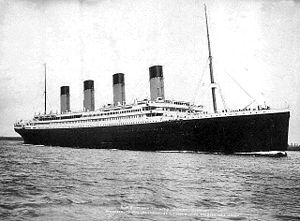
RMS Titanic departing Southampton on 10 April 1912
On April 15th, 1912, RMS Titanic struck an iceberg on her maiden voyage from Southampton, England to New York City and sank, taking over 1500 lives with her.
RMS Titanic departing Southampton on 10 April 1912
On April 15th, 1912, RMS Titanic struck an iceberg on her maiden voyage from Southampton, England to New York City and sank, taking over 1500 lives with her.
Posted in Because I Can, On This Day, Planes Trains and Automobiles
April 17th, 1970 the capsule from the Apollo 13 mission splashed down in the Pacific Ocean, and the whole world breathed a sigh of relief.
Quote
Apollo 13 launched from Cape Canaveral on April 11, intended to be the third manned lunar landing. The crew — James A. Lovell Jr., John L. Swigert Jr. and Fred W. Haise Jr. — experienced a slight vibration shortly after launch, but things were going normally until 55 hours, 55 minutes into the flight.
Oxygen tank No. 2 exploded, causing No. 1 to fail and start leaking rapidly. Warning lights started blinking. The astronaut’s supplies of air, water, light and electricity were imperiled … 200,000 miles from Earth.
Posted in Because I Can, Patriotic
Burl Icle Ivanhoe Ives was an acclaimed American folk music singer, author and actor.
Possibly his most remembered role today is as narrator Sam the Snowman in the Rankin-Bass animated television special, Rudolph the Red-Nosed Reindeer (1964).
Ives’s “A Holly Jolly Christmas” is a very popular tune during the Christmas season, as it’s frequently played on the radio and was featured in the Rudolph the Red-Nosed Reindeer special.
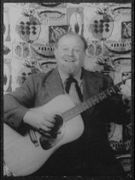
Burl Icle Ivanhoe Ives (14 June 1909 – 14 April 1995)
Posted in Because I Can, Music, The Little Screen (Television)
On this day in 1865, John Wilkes Booth, an actor and Confederate sympathizer, fatally shoots President Abraham Lincoln at a play at Ford’s Theater in Washington, D.C. The attack came only five days after Confederate General Robert E. Lee surrendered his massive army at Appomattox Court House, Virginia, effectively ending the American Civil War.
Booth, a Maryland native born in 1838, who remained in the North during the war despite his Confederate sympathies, initially plotted to capture President Lincoln and take him to Richmond, the Confederate capital. However, on March 20, 1865, the day of the planned kidnapping, the president failed to appear at the spot where Booth and his six fellow conspirators lay in wait. Two weeks later, Richmond fell to Union forces. In April, with Confederate armies near collapse across the South, Booth hatched a desperate plan to save the Confederacy.
Learning that Lincoln was to attend a performance of “Our American Cousin” at Ford’s Theater on April 14, Booth masterminded the simultaneous assassination of Lincoln, Vice President Andrew Johnson and Secretary of State William H. Seward. By murdering the president and two of his possible successors, Booth and his conspirators hoped to throw the U.S. government into disarray.
On the evening of April 14, 1865, conspirator Lewis T. Powell burst into Secretary of State Seward’s home, seriously wounding him and three others, while George A. Atzerodt, assigned to Vice President Johnson, lost his nerve and fled. Meanwhile, just after 10 p.m., Booth entered Lincoln’s private theater box unnoticed and shot the president with a single bullet in the back of his head. Slashing an army officer who rushed at him, Booth leapt to the stage and shouted “Sic semper tyrannis! [Thus always to tyrants]–the South is avenged!” Although Booth broke his leg jumping from Lincoln’s box, he managed to escape Washington on horseback.
The president, mortally wounded, was carried to a lodging house opposite Ford’s Theater. About 7:22 a.m. the next morning, Lincoln, age 56, died–the first U.S. president to be assassinated. Booth, pursued by the army and other secret forces, was finally cornered in a barn near Bowling Green, Virginia, and died from a possibly self-inflicted bullet wound as the barn was burned to the ground. Of the eight other people eventually charged with the conspiracy, four were hanged and four were jailed.
Posted in Because I Can, Patriotic
Don Ho, born Donald Tai Loy Ho (August 13, 1930 – April 14, 2007) was a Hawaiian musician and entertainer. He was best known for his song, “Tiny Bubbles.”
Posted in Because I Can, Music
The founder of Commodore, one of the driving forces in the early history of the personal computers, has died at the age of 83.
Tramiel, born as Jacek Trzmiel to a Jewish family in Poland, emigrated to the US after the Second World War after losing his parents in Hitler’s camps. Tramiel spent time at Auschwitz and at a German labor camp before it was liberated by the US Army in the closing stages of the war. He came to the US and joined the army before setting up his own business, Commodore Business Machines, selling typewriters.
The firm switched to making pocket calculators and ended up buying its own chip business, MOSS, to provide its parts, before making an early move into the personal computer market. Commodore reportedly turned down an offer from Steve Jobs to build the Apple II and produced the Commodore PET (Personal Electronic Transactor), in 1977.
The PET featured a 1MHz MOSS processor, between four and eight kilobytes of RAM, and had a built-in monochrome monitor with an integral cassette player to allow software to be loaded onto the machine. Later versions included a green-screen monitor, integral disc drives, and a full-sized keyboard.
The PET proved popular, and was followed up by the VIC-20 systems, the first PC to sell more than a million units, and the Commodore 64 (C64), which was the bestselling PC of its era.
In the mid-1980s, the C64 was the dominant personal computer in the industry, outselling IBM, Apple, and other contenders. It developed a huge following and was one of the first computers to be sold by retail chains rather than via specialist electronics shops. An estimated 17 million units were eventually sold.
The C64 was much loved, particularly by the gaming community for its ability to handle relatively complex graphics with ease. It proved so popular that a new version, designed to look like the original, is now being sold as a dual-core Atom system, with higher-end versions also available. There’s also a C64 emulator available for the iPhone, including some classic games.
“Jack Tramiel was an immense influence in the consumer electronics and computing industries. A name once uttered in the same vein as Steve Jobs is today, his journey from concentration camp survivor to captain of industry is the stuff of legends,” says Martin Goldberg, a writer working on a book about the Atari brand, speaking with Forbes.
“His legacy are the generations upon generations of computer scientists, engineers, and gamers who had their first exposure to high technology because of his affordable computers – ‘for the masses and not the classes’,” he said.
Commodore’s success proved hard for Tramiel, as he was blamed for kicking off a price war in the computing industry that saw many players either bankrupted or leaving the industry.
In 1984 Tramiel was forced out of the company he founded. Later that year he bought Atari’s struggling computer division and began shipping new systems, including the AtariST, its first 16-bit computer. The company went on to produce PC clones for the general market, and made a foray into the gaming sector with the Atari Lynx and Jaguar brands.
Tramiel stepped back from day-to-day operations at Atari and let his son Sam take over, although he returned to the helm briefly after his son had a heart attack. The company was eventually sold to Atari Inc. in 1996.
He is survived by his wife Helen and three sons.
Posted in Because I Can, News
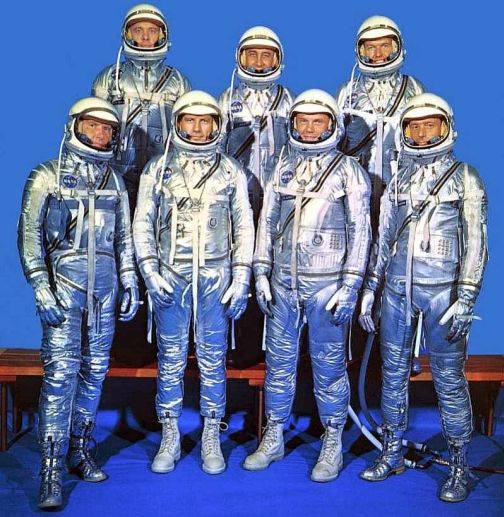
On this day in 1959, NASA announced The Mercury Seven: the seven men to make up their first astronaut class.
The Mercury Seven were chosen in Washington, DC from a body of 69 candidates. The name comes from Mercury, a Roman mythological god who is seen as a symbol of speed. Because of the small space inside the Mercury capsule, candidates could be no taller than 5 feet 11 inches and weigh no more than 180 pounds. The initial flights took off throughout the early 1960s, though some astronauts were active in later decades. Here are the guys:
Malcolm Scott Carpenter (born 1925) was a US Navy piolot aviation cadet who flew missions during the Korean War. He was on board the MA-7 (Aurora 7) and was the first American astronaut to eat solid food in space. He successfully overcame an overexpenditure of fuel due to hardware problems on his one and only mission. Carpenter was forced to retire from spaceflight after sustaining a motorbike accident. After retiring from the Navy, he founded Sea Sciences Inc., a corporation for developing programs for utilizing ocean resources and improving environmental health.
Leroy Gordon (Gordo) Cooper Jr. (1927 – 2004) was very active in the Boy Scouts of America and achieved the second highest rank of Life Scout. Prior to joining NASA, Cooper also served in the US Air Force and Marine Corps. He was on board the MA-9 (Faith 7) and Gemini 5, and developed a personal survival knife for astronauts to carry. Cooper was the first American to sleep in orbit. Interestingly, he took photos of and reported UFO sightings to the Pentagon, but they swept the incident under the rug.
John Herschel Glenn Jr. (born 1921) began his career as a US Marine Corps fighter pilot. He was on board the MA-6 (Friendship 7) and STS-95. Noticed for his heroics in space, Glenn became friendly with the Kennedys and a prominent public figure. After retiring from NASA, he ran as a Democrat and represented the state of Ohio in the United States Senate from 1974 to 1999.
Virgil Ivan (Gus) Grissom (1926 – 1967) was a US Air Force pilot before joining NASA. He was on board the MR-4 (Liberty Bell 7), Gemini 3, and Apollo 1. Grissom was tragically killed along with fellow astronauts Ed White and Roger Chaffee during a pre-launch test for the Apollo 1 mission. After death, his family was involved in a spacesuit controversy: NASA insisted Grissom got authorization to use his spacesuit for a show and tell at his son’s school and never returned it, but his family claimed the he had rescued the spacesuit from a scrap heap and that it rightfully belonged to them.
Walter Marty (Wally) Schirra Jr. (1923 – 2007)’s father was a pilot, and his mother performed wing walking stunts when he was on duty. Schirra served as an officer in the US Navy, and was later dispatched to South Korea as a pilot on loan to the US Air Force. On board the MA-8 (Sigma 7), Gemini 6A, and Apollo 7, he was the only person to fly in all of America’s first three space programs. Schirra gained notoriety for playing “Jingle Bells” on a harmonica he smuggled on board Gemini.
Alan Bartlett Shepard Jr. (1923 – 1998) began as a US Navy as test pilot. He was the first American in space, and flew on board the MR-3 (Freedom 7) and Apollo 14. It’s said that shortly before one launch, Shepard blurted out “Please, dear God, don’t let me fuck up.” This has since become known among aviators as “Shepard’s Prayer.” A successful businessman, Shepard was the first astronaut to become a millionaire while still in the program. His hometown of Derry, NH almost changed its name to “Spacetown” in honor of Schirra’s career.
Donald Kent (Deke) Slayton (1924 – 1993) was also a US Air Force pilot before joining NASA. He was grounded from space flight by a heart condition, but served as NASA’s Director of Flight Crew Operations. Slayton served as head of Astronaut selection. In 1972 he was granted medical clearance to fly as docking module pilot of the Apollo-Soyuz Test Project. At the time of the flight, he became the oldest person to fly into space.
Posted in Because I Can, Patriotic
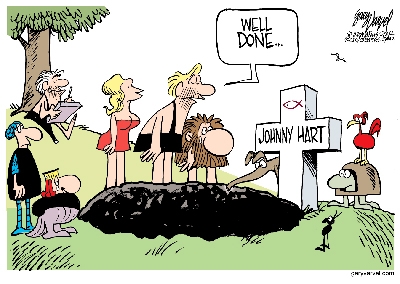
Johnny Hart (February 18, 1931 – April 7, 2007) was an American cartoonist noted as the creator of the comic strip B.C. and co-creator of the strip The Wizard of Id.
Posted in Because I Can, Humor

As brine from the sea ice sinks, a ‘brinicle’ forms threatening life on the sea floor with a frosty fate.
A bizarre underwater “icicle of death” has been filmed by a BBC crew.
With timelapse cameras, specialists recorded salt water being excluded from the sea ice and sinking.
The temperature of this sinking brine, which was well below 0C, caused the water to freeze in an icy sheath around it.
Where the so-called “brinicle” met the sea bed, a web of ice formed that froze everything it touched, including sea urchins and starfish.
The unusual phenomenon was filmed for the first time by cameramen Hugh Miller and Doug Anderson for the BBC One series Frozen Planet
Posted in Because I Can
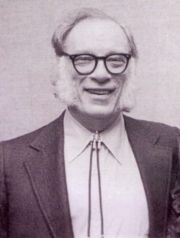
Isaac Asimov (c. January 2, 1920 - April 6, 1992)
Dr. Isaac Asimov was a Russian-born American Jewish author and biochemist, a highly successful and exceptionally prolific writer best known for his works of science fiction and for his popular science books. Asimov’s most famous work is the Foundation Series, which was part of one of his two major series, the Galactic Empire Series, later merged with his other famous story arc, the Robot series. He also wrote mysteries and fantasy, as well as a great amount of non-fiction. Asimov wrote or edited more than 500 volumes and an estimated 90,000 letters or postcards, and he has works in every major category of the Dewey Decimal System except Philosophy. Asimov was by consensus a master of the science-fiction genre and, along with Robert A. Heinlein and Arthur C. Clarke, was considered to be one of the “Big Three” science-fiction writers during his lifetime.
Most of Asimov’s popularized science books explain scientific concepts in a historical way, going back as far as possible to a time when the science in question was at its simplest stage. He often gives nationalities, birth dates and death dates for the scientists he mentions, as well as etymologies and pronunciation guides for technical terms.
The Three Laws of Robotics (often shortened to The Three Laws or Three Laws) are a set of rules devised by the science fiction author Isaac Asimov and later added to. The rules were introduced in his 1942 short story “Runaround”, although they were foreshadowed in a few earlier stories. The Three Laws are:
Posted in Because I Can, Literary
This photo comes from Microsoft co-founder Paul Allen. It show a school (?) of nautiluses devouring some chicken. Allen owns a large yacht called the Octopus, which has a couple of ROVs on board. This photo was taken by one of the ROVs at a depth of 876 feet, near the Pacific island of Palau.

Posted in Critters
This is Alvin, a famous US Navy deep sea submarine. It survived the extreme conditions of deep sea exploration looking for lost hydrogen bombs, surveying the Titanic, and exploring a hydrothermal vent for the first time in history.
But in 1967, it barely survived an encounter with a swordfish. The one sticking out of its hull.
Alvin—named after Woods Hole Oceanographic Institution scientist Allyn Vine—was built in 1964. It was one of the first manned deep sea submarines, a much better vehicle than the original Trieste bathyscaphe, which was too large and hard to maneuver.
Capable of reaching almost 63-percent of the global ocean floor, Alvin became fully operational in July 20, 1965. After its first 6,000-foot US Navy certification dive, the submarine started its run of 4,440 dives across the world.
Its first dangerous mission was the search and rescue of a hydrogen bomb in the Mediterranean sea, off the coast of Palomares, Spain. The bomb fell into the sea after a B-52 collided with a tanker. Alvin and the Navy’s CURV vehicle successfully retrieved it on April 7. Then Alvin had a complete overhaul at Cape Cod.
It was after the overhaul, in 1967, when Alvin got attacked by a swordfish at a depth of around 2,000 feet, during dive number 202—somewhere around the Blake Plateau and Cape Charles, in the Bahamas. The pilots heard a big metallic noise, the whole submarine shook, and something penetrated the outer hull—according to the documentary Superfish.
It was a dangerous situation, so the crew decided to get quickly back to the surface. When its mothership—105-foot catamaran Lulu—lifted Alvin off the surface, they discovered this huge swordfish stuck in the hull.
It may seem impossible, but that’s what happened. It is not that crazy—-according to marine biologist Rick Rosenthal, the producer of the documentary Superfish—these things are extremely aggressive and attack everything, including badass sharks. That’s how these predators—which can weigh 1500 pounds (700 kilograms) and move at 50mph (80km/h)—have survived since prehistoric times.

Posted in Critters
Just after 6 p.m. on April 4, 1968, Martin Luther King Jr. is fatally shot while standing on the balcony outside his second-story room at the Motel Lorraine in Memphis, Tennessee. The civil rights leader was in Memphis to support a sanitation workers’ strike and was on his way to dinner when a bullet struck him in the jaw and severed his spinal cord. King was pronounced dead after his arrival at a Memphis hospital. He was 39 years old.
In the months before his assassination, Martin Luther King became increasingly concerned with the problem of economic inequality in America. He planned an interracial “Poor People’s March” on Washington and in March 1968 had traveled to Memphis in support of poorly treated African-American sanitation workers. On March 28, a workers’ protest march led by King ended in violence and the death of an African-American teenager. King left the city but vowed to return in early April to lead another demonstration.
On April 3, back in Memphis, King gave his last sermon, saying, “We’ve got some difficult days ahead, but it really doesn’t matter with me now. Because I’ve been to the mountaintop. And I don’t mind. Like anybody, I would like to live a long life; longevity has its place. But I’m not concerned about that now. I just want to do God’s will. And he’s allowed me to go up to the mountain, and I’ve looked over, and I’ve seen the promised land. I may not get there with you, but I want you to know tonight that we as a people will get to the promised land.”
One day after speaking those words, Dr. King was shot and killed by a sniper. As word of the assassination spread, riots broke out in cities all across the United States and National Guard troops were deployed in Memphis and Washington, D.C. On April 9, King was laid to rest in his hometown of Atlanta, Georgia. Tens of thousands of people lined the streets to pay tribute to King’s casket as it passed by in a wooden farm cart drawn by a single mule.
The evening of King’s murder, a Remington .30-06 hunting rifle was found on the sidewalk beside a rooming house one block from the Lorraine Motel. During the next several weeks, the rifle, eyewitness reports, and fingerprints on the weapon all implicated a single suspect: escaped convict James Earl Ray. A two-bit criminal, Ray escaped a Missouri prison in April 1967 while serving a sentence for a holdup. In May 1968, a massive manhunt for Ray began. The FBI eventually determined that he had obtained a Canadian passport under a false identity, which at the time was relatively easy.
On June 8, Scotland Yard investigators arrested Ray at a London airport. He was trying to fly to Belgium, with the eventual goal, he later admitted, of reaching Rhodesia. Rhodesia, now called Zimbabwe, was at the time ruled by an oppressive and internationally condemned white minority government. Extradited to the United States, Ray stood before a Memphis judge in March 1969 and pleaded guilty to King’s murder in order to avoid the electric chair. He was sentenced to 99 years in prison.
Three days later, he attempted to withdraw his guilty plea, claiming he was innocent of King’s assassination and had been set up as a patsy in a larger conspiracy. He claimed that in 1967, a mysterious man named “Raoul” had approached him and recruited him into a gunrunning enterprise. On April 4, 1968, he said, he realized that he was to be the fall guy for the King assassination and fled to Canada. Ray’s motion was denied, as were his dozens of other requests for a trial during the next 29 years.
During the 1990s, the widow and children of Martin Luther King Jr. spoke publicly in support of Ray and his claims, calling him innocent and speculating about an assassination conspiracy involving the U.S. government and military. U.S. authorities were, in conspiracists’ minds, implicated circumstantially. FBI Director J. Edgar Hoover obsessed over King, who he thought was under communist influence. For the last six years of his life, King underwent constant wiretapping and harassment by the FBI. Before his death, Dr. King was also monitored by U.S. military intelligence, which may have been asked to watch King after he publicly denounced the Vietnam War in 1967. Furthermore, by calling for radical economic reforms in 1968, including guaranteed annual incomes for all, King was making few new friends in the Cold War-era U.S. government.
Over the years, the assassination has been reexamined by the House Select Committee on Assassinations, the Shelby County, Tennessee, district attorney’s office, and three times by the U.S. Justice Department. The investigations all ended with the same conclusion: James Earl Ray killed Martin Luther King. The House committee acknowledged that a low-level conspiracy might have existed, involving one or more accomplices to Ray, but uncovered no evidence to definitively prove this theory. In addition to the mountain of evidence against him–such as his fingerprints on the murder weapon and his admitted presence at the rooming house on April 4–Ray had a definite motive in assassinating King: hatred. According to his family and friends, he was an outspoken racist who informed them of his intent to kill Dr. Martin Luther King, Jr. He died in 1998.
Posted in Events
On this day in 1860, the first Pony Express mail, traveling by horse and rider relay teams, simultaneously leaves St. Joseph, Missouri, and Sacramento, California. Ten days later, on April 13, the westbound rider and mail packet completed the approximately 1,800-mile journey and arrived in Sacramento, beating the eastbound packet’s arrival in St. Joseph by two days and setting a new standard for speedy mail delivery. Although ultimately short-lived and unprofitable, the Pony Express captivated America’s imagination and helped win federal aid for a more economical overland postal system. It also contributed to the economy of the towns on its route and served the mail-service needs of the American West in the days before the telegraph or an efficient transcontinental railroad.
The Pony Express debuted at a time before radios and telephones, when California, which achieved statehood in 1850, was still largely cut off from the eastern part of the country. Letters sent from New York to the West Coast traveled by ship, which typically took at least a month, or by stagecoach on the recently established Butterfield Express overland route, which could take from three weeks to many months to arrive. Compared to the snail’s pace of the existing delivery methods, the Pony Express’ average delivery time of 10 days seemed like lightning speed.
The Pony Express Company, the brainchild of William H. Russell, William Bradford Waddell and Alexander Majors, owners of a freight business, was set up over 150 relay stations along a pioneer trail across the present-day states of Missouri, Kansas, Nebraska, Wyoming, Colorado, Utah, Nevada and California. Riders, who were paid approximately per week and carried loads estimated at up to 20 pounds of mail, were changed every 75 to 100 miles, with horses switched out every 10 to 15 miles. Among the riders was the legendary frontiersman and showman William “Buffalo Bill” Cody (1846-1917), who reportedly signed on with the Pony Express at age 14. The company’s riders set their fastest time with Lincoln’s inaugural address, which was delivered in just less than eight days.
The initial cost of Pony Express delivery was for every half-ounce of mail. The company began as a private enterprise and its owners hoped to gain a profitable delivery contract from the U.S. government, but that never happened. With the advent of the first transcontinental telegraph line in October 1861, the Pony Express ceased operations. However, the legend of the lone Pony Express rider galloping across the Old West frontier to deliver the mail lives on today
Posted in Critters

Thunder Over Louisville continues to deliver a pyrotechnics spectacular like no other. Created as the Opening Ceremonies of the Kentucky Derby Festival, it offers an explosive kick-off to two entire weeks of celebration in Louisville, Kentucky and Southern Indiana. With an estimated average attendance of half a million people, it has become the largest annual event in its region.
The show continues to be the largest annual pyrotechnics display in North America thanks to the artistry of Zambelli Internationale and the production of Visual Presentations.
Posted in Because I Can
2012 Mid-America Trucking Show | March 22 – 24, 2012 | Louisville, KY at the Kentucky Exposition Center

Posted in Because I Can, Planes Trains and Automobiles
Sir Arthur Charles Clarke, (16 December 1917 – 19 March 2008) was a British science fiction author, inventor, and futurist, most famous for his novel 2001: A Space Odyssey, and for collaborating with director Stanley Kubrick on the film of the same name.
Posted in Literary